Hoppers Marylebone is a high-demand, mid-priced Sri Lankan and South Indian restaurant that combines street-food cooking with an architect-designed setting and a firmly managed booking system. Diners can expect bold flavours, high noise levels, a strong cocktail and arrack offering and a bill that typically lands between £40 and £70 per head with drinks.
Opened in 2017 as the second outpost of the Hoppers brand from JKS Restaurants, this site translates the original Soho venue’s “toddy shop” energy into something more structured for the Marylebone and West End crowd. The food remains rooted in the cooking of Sri Lanka and Tamil Nadu, but the Marylebone branch layers on a more polished service style, an architectural concept driven by Tropical Modernism and the cachet of a Michelin Bib Gourmand, retained into 2025.
The result is a restaurant that operates at an interesting midpoint. It is casual in pace and presentation, serious in technique, and busy enough that understanding how it works is essential for anyone planning to use it for client entertaining, research visits or personal dining.
Inside the tropical modernist design and atmosphere
Hoppers Marylebone has been built as much as a design statement as a place to eat. The reference point is Geoffrey Bawa, the Sri Lankan architect associated with Tropical Modernism, and that influence is visible throughout the space.
The ground floor brings diners straight from Wigmore Street into a cool, hard-surfaced room of concrete, tile, and carefully placed greenery. Polished floors and terracotta tiles meet rattan chairs, timber detailing and ceilings dressed with batik-style fabrics that nod to Sri Lankan textile traditions. The effect is not nostalgic colonial styling but a modern interpretation of Sri Lankan villa architecture, translated into a compact London plot.
The lower ground floor shifts the mood. Here, semi-private “vaults” create enclosed dining spaces for small groups. These vaults are particularly useful for work dinners or family gatherings where guests want to be part of the restaurant’s energy without sitting in the front window. They also give some visual privacy in a dining room that is otherwise very exposed.
The design has a clear consequence. Noise levels are high. Hard surfaces bounce sound, and a soundtrack of Sri Lankan pop and baila, combined with tightly packed tables and a full reservation book, creates a loud, buzzy environment. Reviews consistently describe Hoppers Marylebone as energetic. It is ideal for animated conversation and shared plates, less so for confidential meetings or people who are very noise sensitive.
Ground floor tables look straight onto Wigmore Street, offering strong people watching and a sense of the West End just beyond the glass. Downstairs is darker and more cocooned, with a clubbier feel. Choosing between levels is an important part of planning a visit.
How Hoppers Marylebone fits into central London
The restaurant occupies a strategic corner at 77 Wigmore Street, right where James Street becomes the gateway into St Christopher’s Place. In practical terms, this puts Hoppers at the hinge between Marylebone Village and the Oxford Street shopping corridor, close to high-end retail but slightly removed from the heaviest footfall.
For most diners, Bond Street station is the key transport link. A walk of around 5 minutes brings guests from the Central, Jubilee and Elizabeth Line platforms to the front door. The newer Elizabeth Line connections from Canary Wharf and the City have made it realistic for office workers in those districts to use Hoppers for lunch or early evening meals. Oxford Circus, roughly 8 minutes away on foot, opens up the Bakerloo and Victoria lines.
Bus routes along Wigmore Street, including the 98 and 390, provide additional connectivity. There is no on site parking. Drivers, particularly Blue Badge holders, need to rely on nearby street bays and council-provided parking on adjacent streets, such as Marylebone Lane, which requires checking local maps and restrictions in advance.
This positioning gives Hoppers Marylebone a dual function. It is a neighbourhood restaurant for local residents and professionals, and a destination venue for visitors already in the West End for shopping, theatre or meetings who are looking specifically for Sri Lankan food in central London.
Accessibility and child policies for informed visits
For researchers, policymakers and diners concerned with inclusive design, Hoppers Marylebone is a typical example of the trade-offs that come with adapting period West End buildings.
The main entrance is step-free from the pavement, with manual doors giving level access to the ground floor. A small number of tables on this level are usable for wheelchair users, but capacity is explicitly limited. The restaurant advises booking early and requesting ground-floor seating for any group that includes a wheelchair user, as only up to 3 guests can be accommodated in this way at once.
Sanitary provision is more constrained. There is an “accessible” toilet at ground level, but it does not meet all formal standards set by specialist auditing bodies. Transfer space and layout fall short of full compliance. Additional toilets, including gender-neutral options, are on the lower ground floor and accessed via stairs. There is no lift between levels, which effectively puts the vaults and those facilities out of reach for some disabled diners.
Families are generally welcome, but there is a clear child policy around evenings. Children under 7 are subject to restrictions after 19:00, reflecting the intensity of the nighttime service and the narrowness of the space. For early family dinners, lunch or early evening bookings are more appropriate.
Booking strategies and the walk-in system
Demand for Hoppers Marylebone regularly exceeds the number of covers available, especially at peak times and at weekends. Anyone planning to use it for an important occasion needs to understand the booking system.
Reservations are generally released 3 months in advance and are handled through the restaurant’s own website or the SevenRooms platform. Online booking typically covers parties from 1 to around 10 guests. Larger tables, often from 8 people upwards, are directed towards pre-set Feast menus which simplify ordering and guarantee a balanced spread of dishes.
On weekdays, the restaurant runs a split service model. Lunch usually runs from 12:00 to 15:00, followed by a firm closed period while the kitchen resets, and then dinner from either 17:00 or 17:30 through to late evening depending on the day. The gap between services is not negotiable, which matters for anyone trying to hold a late working lunch that risks overrunning into the closure window.
Weekends work differently. Saturday is an all-day service from midday through to late evening, and Sunday runs a continuous but slightly shorter day until around 21:30. For casual visitors, this continuous service on weekends can make walk-ins more viable.
All bookings require card authentication, and Hoppers applies a cancellation fee for no-shows or late cancellations within a stated window, typically 24 to 48 hours. Historical figures suggest a fee in the £20 to £30 per person range, though the exact amount and terms are subject to change and should always be checked at the time of booking.
Alongside reservations, Hoppers maintains a walk-in culture. A portion of tables is held back, and once those are taken, hopeful diners are added to a digital waitlist. This virtual queue is integrated with messaging, allowing guests to explore St Christopher’s Place and nearby shops while waiting for a table. The most reliable tactic for walk-ins is to arrive at the very start of service at either 12:00 or the first evening sitting.
Outdoor tables on the terrace add further capacity in warmer months. In practice, these seats are often set aside primarily for walk-ins, and they carry the benefit and drawback of a direct relationship with Wigmore Street traffic.
How the menu works from short eats to karis
The Hoppers Marylebone food offer is built around Sri Lankan and Tamil street food, designed for sharing and often eaten with the hands. Spice levels are unapologetically assertive, with liberal use of black pepper, dried red chillies and fresh green chillies.
The meal typically begins with Short Eats, a category of snack dishes drawn from Sri Lankan roadside culture. Mutton Rolls bring slow-cooked spiced mutton and potato, wrapped, crumbed, and deep-fried for a crisp exterior and a soft interior, accompanied by a sweet-hot “Lankan ketchup”. Bone Marrow Varuval with Roti has become a cult favourite, combining roasted beef marrow bones with a Chettinad-style sauce heavy on coconut, tomato and toasted spices, served with flaky roti for scooping.
Other regulars such as Hot Butter Squid and Devilled Paneer reflect the long-standing Chinese influence on Sri Lankan cookery. The squid arrives crisp, salty and coated in butter, garlic and chilli, while the paneer is tossed in a fiery, sticky stir fry with tomatoes and spring onions that speaks directly to the so-called “Lankan Chinese” canon.
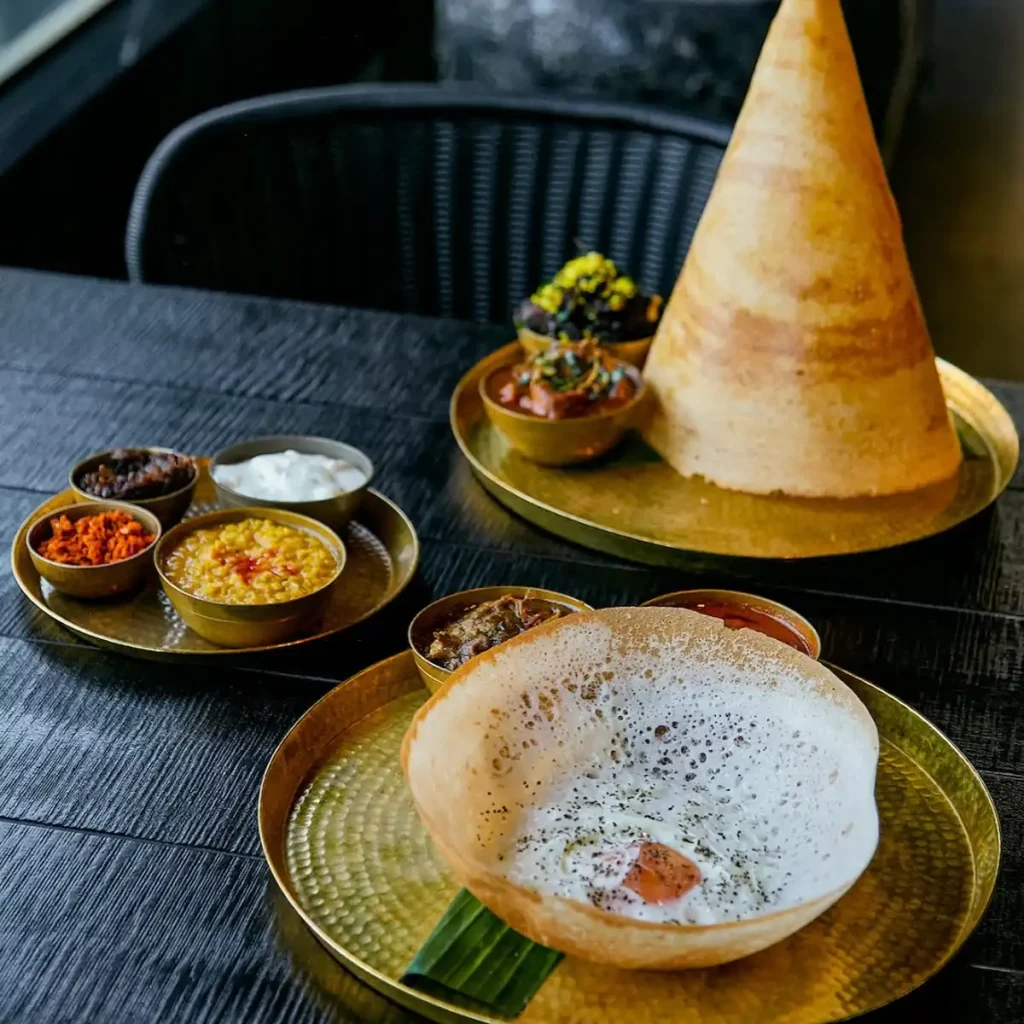
The next layer is the central carbohydrate: the Hopper itself, alongside Dosas and String Hoppers. The classic hopper is made from a fermented batter of rice and coconut milk, cooked into a delicate bowl shape with lacy, crisp edges and a soft, airy centre. The Egg Hopper, with an egg set at the base, is a signature image of the brand. These are typically paired with relishes such as Pol Sambol (coconut), Seeni Sambol (slow-cooked onion) and Lunu Miris (chilli paste), forming a base for the rest of the meal.
Dosas use a different fermented batter of rice and lentils and are cooked flat, then folded or rolled. They are familiar to diners who know South Indian food and arrive with chutneys and sambar. String Hoppers, by contrast, are delicate steamed noodle nests made from rice flour, ideal for soaking up lighter, brothy curries like Kiri Hodi, the classic coconut milk gravy.
Main dishes are organised as Karis, the restaurant’s term for its core curries. The Black Pork Kari is a headline plate, using deeply roasted “black curry powder” and goraka, a sour dried fruit, to build a dark, smoky sauce around slow-cooked pork. Crab often appears as a market-priced special, served cracked in a rich coconut curry that demands bibs and hand washing.
Another essential is Lamb Kothu Roti, in which godamba roti is chopped and smashed on a hotplate with lamb curry, egg, onion and vegetables. Heavy and comforting, it echoes the rhythm and theatre of Sri Lankan street stalls as it arrives in a controlled Marylebone setting.
For most tables, the best approach is to order a spread of short eats, a couple of karis, a mix of hoppers, dosas or string hoppers and a side or two. This suits the restaurant’s family-style sharing ethos and ensures that the full breadth of texture and spice is experienced.
Plant-based options for feasts and dietary needs
One of the strengths of Hoppers Marylebone is the breadth of its vegetarian and vegan offerings. Rather than treating plant-based diners as an afterthought, the restaurant provides a dedicated Vegetarian and Vegan menu, building on the natural prevalence of meat-free dishes in South Asian cooking.
Plates such as Aubergine Kari in a sweet-sour “moju” style, Jaffna Jackfruit Kari with its strikingly meaty texture and the Dhal Kari with spinach and squash give depth and variety to menus for those who avoid meat. The plain Hopper and Dosa are naturally vegan, being based on rice and lentils or rice and coconut milk, and are also gluten-free. The Egg Hopper is suitable for vegetarians.
Groups are strongly encouraged to use structured Feast menus, which serve both the kitchen and the guests. These feasts, priced in the broad band from the mid £50s to mid £60s per head, rotate through themes. Buriani focused feasts centre on aromatic rice dishes with accompaniments, while barbecue-themed feasts highlight larger grilled fish or chicken. The Signature Kari Feast often features slow-cooked lamb shank and other higher-priced preparations, offering a fuller view of the kitchen’s ambitions.
Dietary notes are clear. Chicken and lamb are Halal, but pork is used in dishes such as the Black Pork Kari, and alcohol is integral to both the bar and the cooking, so the kitchen is not Halal certified. Guests with strict requirements need to discuss cross-contamination procedures with staff. Nuts, particularly cashews, appear frequently across the menu, and gluten is present in some Short Eats and in Kothu Roti.
Arrack cocktails and the drinks programme
The drinks list at Hoppers Marylebone is built as a partner to the food, with a particular emphasis on Ceylon arrack, the traditional spirit distilled from coconut flower sap. The bar treats arrack not as a novelty but as a serious category, framing it for drinkers who usually order whisky, rum or classic cocktails.
Fun fact: Toddy tappers collect sap for Ceylon arrack by walking on ropes strung high between palm trees, often covering long distances without touching the ground.
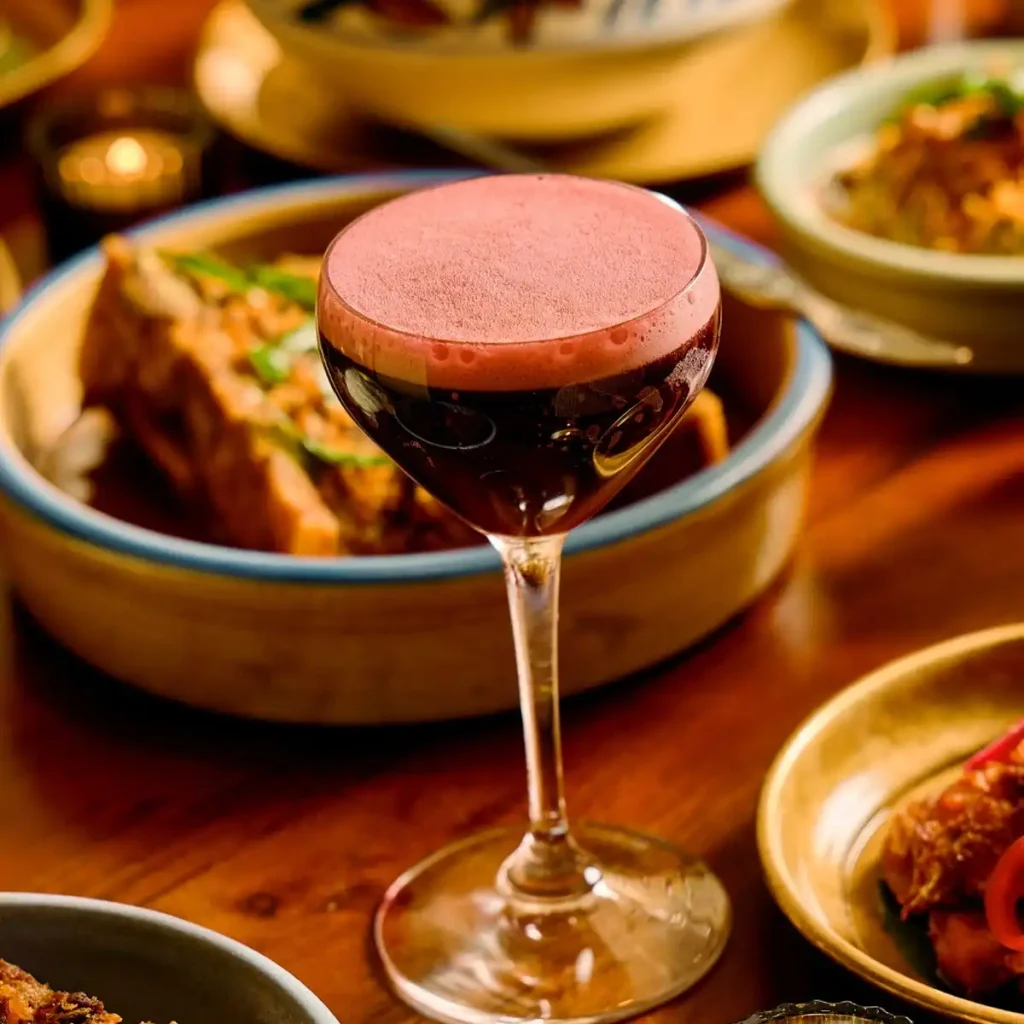
Signature serves such as the Arrack Attack use a highball format, pairing arrack with house-made ginger beer and lime. The ginger beer is notably spicy and cloudy, giving enough structure to stand up to heavy use of chilli and fat in the food. Old Ceylon interprets the Old Fashioned through an arrack, whisky and palm sugar lens, adding depth and sweetness without overwhelming the underlying spirit.
The broader cocktail list is billed as “Tropical Modernism in a glass” and draws on ingredients such as green mango, turmeric, tamarind, and curry leaves. A Mango Gimlet might use mango-infused vodka and clarified lime cordial, while Watermelon Kandy arrives as a frozen gin-based drink with watermelon and sour mango powder that fits neatly with summer terrace service. A Pandan Negroni introduces pandan-scented gin and coconut-accented bitters into the mix, giving a nutty, aromatic twist on a classic template.
Non-drinkers are deliberately catered for. The Wattalapam Lassi translates a much-loved Sri Lankan dessert into a drinkable format with coconut, malt, yoghurt, jaggery and nutmeg. The house ginger beer is available unspiked and is more complex than many commercial soft drinks, with coriander seed and lime in the mix.
For professionals assessing London’s drinks culture, Hoppers Marylebone is a useful example of how a focused spirit category can be woven into a broader programme without alienating mainstream guests.
How Hoppers compares with Marylebone neighbours
Marylebone is one of London’s densest restaurant neighbourhoods, and Hoppers sits in direct and indirect competition with several notable venues. For a clear sense of the landscape, four near neighbours matter in particular.
Trishna, on Blandford Street, is effectively Hoppers’ older sibling within the JKS Restaurants group. It offers coastal Indian cooking in a white tablecloth, wine-led setting and holds a Michelin star. Where Hoppers is loud, informal and centred on street food dishes, Trishna is controlled, calm and built around longer, multi-course meals. It is a better choice for business meetings that require quiet conversation.
Roti Chai, just off Oxford Street on Portman Mews, offers a dual concept: a casual “Street Kitchen” and a more polished “Dining Room”. The focus leans more towards North Indian cooking, and the space flexes between quick, informal meals and smarter dinners.
Jikoni, also on Blandford Street, positions itself as “no borders” cooking, blending influences from East Africa, the Middle East and South Asia. The room is softer and more domestic in feel, with a bohemian, cosy atmosphere that supports brunch as much as dinner.
Elsewhere, Kolamba has built a reputation with a gentler, design-led take on Sri Lankan home cooking. The Soho original and newer East London branch overlap with Hoppers in terms of cuisine but deliver a calmer dining room and a less explicit focus on the “devilled” and street food dishes that define the Hoppers brand.
Within this set, Hoppers Marylebone is clearly the loudest and most street food-oriented. It prioritises energy and shared plates, making it the obvious choice for celebratory group dinners or social outings. Trishna fits suits and quiet negotiations. Jikoni lends itself to weekend catch-ups. Roti Chai remains a fast, adaptable option for central London office workers.
Practical tips for getting the best experience
For diners and planners, a small number of practical points can make the difference between a frustrating and a successful visit.
Dress is smart casual. On any given evening, tables might mix Marylebone office workers in tailoring, tourists in comfortable clothes and couples in more dressed-up outfits. There is no formal dress code, but the design of the room and the pricing encourage a certain level of polish.
Eating with hands is not just accepted but encouraged. Hoppers provides wet wipes and washing facilities, and the texture of hoppers, dosas and sambols is best appreciated by tearing, scooping and mixing directly. Guests who are not used to this style of eating may want to sit with others who are comfortable guiding them.
Payment is card only, reflecting a broader London trend towards cashless service. A discretionary 12.5% service charge is added to the bill, which is standard for central London and shared among the team. Additional cash tipping is rare but not unknown.
Table selection matters. For people watching, the window seats on the ground floor offer views straight onto Wigmore Street and the flow of St Christopher’s Place. For privacy, the lower-ground “vaults” work well for groups of 4 to 6, though they are not accessible to anyone who cannot manage stairs. Solo diners are well served by smaller tables and counter seats, and a simple combination of a Hopper and a Kari makes a compact, satisfying meal.
Why Hoppers Marylebone matters in London’s dining scene
Hoppers Marylebone occupies an important position in the evolution of South Asian dining in London. It brings the flavours and formats of Sri Lankan and Tamil street food into a central, design-conscious setting, backed by operational systems robust enough to handle very high demand. With its Bib Gourmand recognition, its commitment to a distinctive architectural identity and its careful balance of reservations and walk-ins, it demonstrates how specialist regional food can move from niche to mainstream without losing character.
For policymakers and researchers, the site offers a case study in the challenges of accessibility in older building stock, the impact of new transport links on lunchtime trade and the way diaspora cuisines are shaping the capital’s mid-market restaurant layer. For diners, it is simply one of the most focused places to experience Sri Lankan street food in central London, provided they come prepared for noise, heat and a firmly run booking system.
In a city where restaurant trends shift quickly, Hoppers Marylebone has settled into something like a modern classic. Its combination of Tropical Modernist design, arrack-driven drinks and richly seasoned cooking continues to draw both local regulars and international visitors. Like the best hoppers, it balances crisp structure with a soft, generous centre, offering Londoners a vivid, hands-on route into one of the subcontinent’s most distinctive food cultures.