Marylebone Station is both an outlier and a test case for the future of Britain’s railways. It is London’s youngest and smallest mainline terminus, the only one not run day to day by Network Rail, and still wholly reliant on a diesel fleet in a city that has committed to Net Zero. At the same time, it is a high-performing gateway to the Chilterns, Oxford and Birmingham, a station with strong passenger satisfaction scores and a reputation for calm in a capital of crowded concourses.
Its history traces a striking arc. Conceived in the 1890s as the London end of a visionary corridor between Manchester and Paris, it survived mid-twentieth-century rationalisation, a serious closure proposal in the 1980s, and years of underinvestment. Its fortunes were transformed under Chiltern Railways, whose unusual long lease and control of infrastructure enabled the Project Evergreen works that rebuilt the line and created a new main line to Oxford.
Now, Marylebone is approaching another turning point. It remains the only non-electrified London terminus, exposed to tightening air quality rules and national decarbonisation targets. The operator’s Right Route 2030 concept, centred on battery electric or hybrid trains, seeks to remove diesel from the platforms without the cost and disruption of full overhead wiring. How that transition is funded and governed will shape not only the future of this compact station, but also the wider debate on how Britain modernises secondary main lines. At the same time, money is tight, and expectations on environmental performance are rising.
Marylebone Today Diesel Island In An Electric Capital
Marylebone now functions as a compact National Rail terminus with the feel of a local station but the complexity of an intercity hub. It is distinctive because the station is not directly managed by Network Rail, and because all services are still diesel-powered.
The freehold of the site is held by Network Rail, yet the day-to-day running of the station, the platforms, and the associated infrastructure rests with Chiltern Railways, part of the Arriva group. In practice, this means decisions about maintenance, retail and small-scale capital works are taken locally rather than through the national station management structure used at Euston, Waterloo or Paddington. Suppose the roof leaks or toilets need upgrading. In that case, it is for Chiltern to specify and deliver the fix rather than relying on a central major stations team.
This arrangement has commercial consequences. At most London termini, retail income flows primarily to Network Rail. At Marylebone, retail revenue is retained or shared in ways that strengthen the case for investment in the concourse and customer facilities. National passenger surveys consistently report strong scores for cleanliness and staff helpfulness, and the station’s compact layout avoids the long walking distances associated with larger hubs.
Operationally, Marylebone acts as the southern anchor for four overlapping markets. Fast Birmingham services compete with Avanti West Coast out of Euston. Frequent trains to Oxford and Oxford Parkway via Bicester Village serve both university and visitor traffic. Suburban trains head towards Aylesbury and the historic Metropolitan commuter belt, sharing tracks with the London Underground in places, while stopping services cover intermediate towns such as High Wycombe and Gerrards Cross. The station therefore combines commuter flows, university traffic and international tourists, particularly shoppers heading to the Bicester outlet.
How A Quiet Terminus Became A Strategic Testbed
The modern structure at Marylebone is the product of a particular form of privatisation-era entrepreneurship. The station survived earlier attempts at closure, but it was the 1996 M40 Trains management buyout that turned a fading commuter backwater into a laboratory for vertically integrated rail operation.
When the Chiltern franchise was let in the mid-1990s, Adrian Shooter and his team secured a long-term deal which, unusually, handed them not only the right to run services but also management control over much of the infrastructure. Unlike most Train Operating Companies, which lease stations while Network Rail manages the tracks and structures, Chiltern Railways took responsibility for the station, portions of the track and key signalling assets for an extended period.
This vertical integration aligned incentives in a way rarely seen elsewhere on the network. Investments in new platforms, line speed improvements or expanded capacity were not dependent on central Control Period funding cycles. Instead, Chiltern could borrow against future revenue and use Special Purpose Vehicles to finance projects that would improve punctuality, capacity and market share, while also enhancing the value of its own business.
The headline result was Project Evergreen, delivered in three phases. Evergreen 1 reinstated double track between Princes Risborough and Bicester North, reversing cost-saving singling that had constrained resilience. Evergreen 2 transformed Marylebone itself by turning the long unused western side of the station into platforms 5 and 6, which significantly increased the number of trains that could be turned in the peak. Evergreen 3 then created a new high-speed connection towards Oxford, including a new chord at Bicester and line speed upgrades to around 100mph.
The effect was to recast Marylebone as the southern end of a revitalised Chiltern Main Line, offering business-friendly trains to Birmingham and Oxford that were marketed as an alternative to the traditional Great Western Railway and West Coast routes. Passenger numbers rose from roughly 6 million entries and exits in the early 2000s to more than 16 million on the eve of the pandemic, with the station handling a disproportionate share of discretionary and leisure travel compared with its size.
From Great Central Ambition To Near Extinction
To understand why Marylebone today is both small and strategically important, it is necessary to look back at its late and contested entry into London’s railway geography.
The station was the southern terminus of the Great Central Railway London Extension, driven by Sir Edward Watkin, the ambitious chairman of the Manchester, Sheffield and Lincolnshire Railway. Frustrated by reliance on other companies to reach the capital, he envisaged a through corridor from the industrial north of England to Paris via a future Channel Tunnel. That vision demanded a line engineered to generous loading-gauge standards, able, in theory, to accommodate continental wagon profiles and larger rolling stock than domestic rivals. The generous structure clearances would later support the carriage of large freight containers. However, the later truncation of the route limited that potential.
Securing a path into central London involved a fierce political struggle. The alignment through St John’s Wood alarmed residents, who feared noise, smoke, and the loss of early garden-suburb character. Most controversial of all, the proposed route passed beneath Lord’s Cricket Ground, home of the Marylebone Cricket Club. Parliamentary approval in 1893 came only after the railway undertook to tunnel under the nursery end of the ground using cut-and-cover methods, to provide alternative practice facilities and to take on high additional cost and risk.
At the terminus, the chosen site around Blandford Square demanded the demolition of working-class housing. Streets such as Harewood Square and parts of Boston Place were cleared to make way for the approach tracks and station throat. The cost of tunnelling, land purchase and construction pushed the company towards the limits of its finances even before the first train ran.
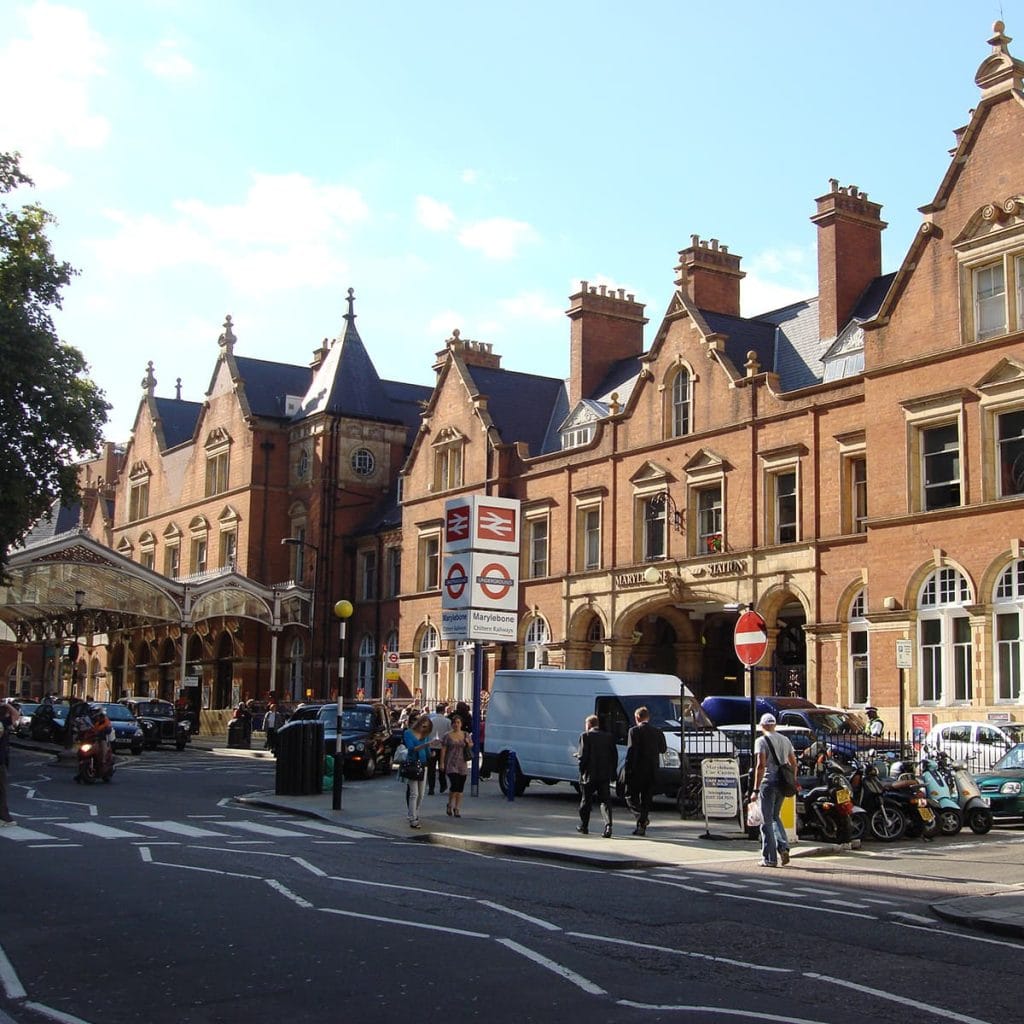
When Marylebone Station opened to passengers in March 1899, it was therefore far more modest than first envisaged. Planned as a significant multi-platform cathedral of steam, it opened with only four platforms, despite land having been acquired for eight. Architect Henry William Braddock designed a red-brick building with buff terracotta that echoed the mansion blocks around it rather than the monumental Gothic of St Pancras or the neoclassical statements elsewhere in London. The result has often been compared to an Edwardian civic library or hotel, with a human-scale frontage that still shapes the station’s atmosphere today.
In the early decades, the Great Central attempted to position Marylebone as a premium departure point through named expresses such as the Master Cutler and the South Yorkshireman, which offered comfortable dining services towards Sheffield and Bradford. Yet the route into London was longer and less direct than competing lines. By the time the railways were grouped into the LNER and other big four companies in 1923, Marylebone had acquired a reputation as the quiet terminus. This image would persist long into the British Rail era.
Nationalisation after 1948 placed the route under British Railways, first in the Eastern Region and later the London Midland Region. The Great Central Main Line was increasingly treated as a duplicate of the Midland and West Coast routes. The 1963 Beeching Report identified the line north of Aylesbury as surplus, and by 1966, long-distance services to Sheffield, Manchester and Nottingham had gone. Marylebone was reduced to local and commuter services on a diesel multiple unit railway, with the grander ambitions of the Victorian promoters reduced to memory.
By the early 1980s, the station looked tired. The train shed roof was dirty, paint was flaking, and the unused western side of the site was turned over to access roads and parking. British Rail developed a radical closure proposal that would have shut the station entirely, diverted remaining trains elsewhere and reused the trackbed as a dedicated coach road for long-distance buses. Technical studies eventually showed that turning narrow Victorian tunnels and viaducts into a two-way road was both expensive and complex. Local campaigners, residents and figures such as Poet Laureate Sir John Betjeman mounted a visible resistance, arguing that the station and its Metro land catchment had cultural as well as transport value. In the end, engineering risk and organised opposition combined to keep Marylebone open, albeit with minimal investment until the franchise era.
Fun fact: Marylebone is the youngest of London’s main line termini, opening in 1899, more than 50 years after Euston and Paddington began receiving trains.
Passenger Flows Experience And Station Character
Current passenger data illustrates how Marylebone occupies a niche between the giant London terminals and the most constrained City stations. It handles large numbers while maintaining a scale that keeps the building comfortable to use.
On a typical weekday morning, just over 10,000 passengers arrive between 07:00 and 09:59. That is roughly a tenth of the volume handled at Liverpool Street, which sees more than 100,000 arrivals in the same window. Annual entries and exits at Marylebone before the pandemic were around 16 million. During the lockdown in 2020 to 2021, they fell to around 2 million, and by 2023 to 2024 had recovered to approximately 11 million. Interchange numbers are relatively low compared with hubs such as Waterloo or King’s Cross, because Marylebone mainly serves as a start and finish point, with most passengers walking into the West End or transferring once onto the Underground rather than changing between multiple mainline services.
These figures shape the experience on the ground. Crowding levels in the peaks are real but typically less intense than at Cannon Street or Fenchurch Street, where heavy commuter flows from single corridors can produce high standing densities and extended queuing. At Marylebone, the shorter walks between entrance, ticket gates and platforms make it easier to clear peaks, and there is space for waiting and circulation on the concourse.
The station environment has been curated to reflect both its affluent catchment and the expectations of business travellers and visitors. The main concourse is an airy, single-volume space under steel and glass, with clear sight lines and minimal level changes. Retail provision leans towards premium convenience rather than basic refreshments, with operators such as M&S Food, Pret, Starbucks, a flower stall and personal services including a barber and shoe shine.


A focal point is the Victoria and Albert pub on the concourse, a Grade II-listed venue with curved bar counters, traditional woodwork and decorative plasterwork. Where many station pubs have been recast in generic formats, this one retains an individual character and draws in both travellers and local office workers. The combination of heritage architecture and modern retail has helped build a perception of Marylebone as a station where waiting time feels less stressful than at larger hubs.
Accessibility is one of Marylebone’s strongest features. The National Rail station is rated Step Free Category A, meaning passengers can move from the street to the platform without using lifts or stairs. The approach from Melcombe Place, the taxi rank, and the ticket hall all sit on a single level with the platforms. That simplicity contrasts with several other London termini, where lifts, subways and bridge structures complicate step-free routes. The main constraint lies not in the rail station but in the connecting Bakerloo line platforms, which remain accessed by escalators and are not step-free.
The area around the station is also changing. As part of the Baker Street Quarter Partnership plans, the secondary entrance on Harewood Avenue is earmarked for improvements, including new fire safety infrastructure, better lighting and planting to soften the street frontage. Alongside that, a so-called Green Link between Marylebone and Baker Street stations is being promoted through wider pavements, planters and clearer wayfinding to encourage passengers to walk the short distance instead of making a one-stop tube journey.
Diesel Pollution, Noise And Community Pressure
Success in performance and customer satisfaction does not mask the environmental challenges that accompany a fully diesel operation in central London. Those pressures are becoming more acute as city-wide air quality standards tighten and as public expectations evolve.
All trains using Marylebone Station are currently diesel-powered. The core fleet comprises Class 165 Networker Turbo units dating from the early 1990s, Class 168 Clubman units introduced from the late 1990s, and locomotive-hauled sets formed of Class 68 locomotives and refurbished Mark 3 coaches. The refurbished trains offer comfortable seating, tables, power sockets and business-style interiors, but the locomotives that haul them are heavy and noisy. When they idle in the platforms, their engines produce both low-frequency vibration and visible exhaust, particularly noticeable under the train shed.
Air quality within and around the station is a persistent concern for residents and campaigners. Nitrogen oxides and fine particulate matter from diesel exhausts contribute to local pollution, even with a high roof and ventilation. In response, Marylebone has trialled so-called Clean Air Zones on the concourse, where advertising totems house industrial filters that draw in polluted air and emit cleaner air in return. These installations provide a visible statement of intent and some local benefit, but they do not remove the underlying dependence on diesel traction.
Noise is the other major environmental pressure. Marylebone is hemmed in by residential blocks around Blandford Square and Dorset Square. Residents have long complained about the continuous low-frequency note of idling locomotives, particularly in early morning and late evening. In reaction, Chiltern Railways has introduced stop-start systems on some units, revised stabling patterns so more trains are parked overnight at depots such as Wembley and Stourbridge rather than at platforms, and reinforced operational rules that require drivers to shut down engines when dwell times allow.
To reduce the carbon impact of the locomotive-hauled sets before new trains arrive, Chiltern has been trialling Hydrotreated Vegetable Oil (HVO) fuel in Class 68s. HVO is produced from waste oils and can cut net greenhouse gas emissions significantly compared to conventional diesel, as well as improving particulate performance. The trials position Marylebone as a test location for interim decarbonisation measures on legacy diesel fleets, even as longer-term fleet renewal remains the only full solution.
Performance data shows how ageing diesel fleets can affect reliability. Historically, the Chiltern route achieved Public Performance Measure scores above 90%. By 2024, figures had eased back, with around 67.7% of trains recorded as on time within 59 seconds, around 85.2% within five or ten minutes and cancellations at a little over 4%. Those numbers remain competitive by national standards, yet the downward trend underlines the link between asset age, maintenance risk and resilience, especially on a network that makes intensive use of its rolling stock.
Social Value, Charity Links, And Local Economy
Marylebone’s footprint in the city extends beyond transport metrics. The station provides a stage for local social projects and underpins parts of the Westminster economy.
Chiltern has adopted a structured social value programme centred on partnerships with local organisations. One of the most visible is the link with The Marylebone Project, which supports women experiencing homelessness. The station has hosted exhibitions such as Marylebone on Display, where artwork produced by women from the project during a twelve-week course was shown on the platforms. Such initiatives bring social issues into the line of sight of commuters and visitors, using the station as an informal gallery as well as a transport hub.
Fundraising events and donation points at the station connect relatively affluent daily users with local need, while also helping to soften the image of a privatised railway operator. The relationship reflects a broader trend in which transport assets are used to support community engagement, yet here it is rooted in specific place-based relationships rather than generic corporate branding.
Economically, Marylebone delivers steady footfall for nearby offices, shops and visitor attractions. The station feeds workers into the Baker Street office cluster and brings shoppers and diners into Marylebone High Street. Tourists who arrive by rail for Madame Tussauds, the Sherlock Holmes Museum and other attractions add to local spending on hospitality and retail. Westminster City Council’s analysis of a resilient, service-led borough economy is underpinned in part by the continued strength of these transport links.
Right Route 2030 And The Next Marylebone
Looking ahead, the central strategic question is how quickly and in what form Marylebone Station can shed its diesel dependency. The Right Route 2030 vision set out by Chiltern offers a pragmatic approach that balances decarbonisation with affordability.
Rather than proposing full electrification of every mile between London and Birmingham, which would involve high capital cost and complex engineering on a busy mixed traffic corridor, the plan envisages a new fleet of Battery Electric Multiple Units (BEMUs) or comparable hybrids. These trains would draw current from overhead wires where available and run on battery power on non-electrified sections, including the final approaches into Marylebone.
If delivered, such a fleet would remove tailpipe emissions from the station environment entirely, improving air quality on the concourse and platforms and eliminating locomotive noise at source. Better acceleration and braking profiles would also help reduce journey times and increase capacity on constrained sections of line, particularly where mixed with other operators.
The timeline envisaged in the vision suggests procurement and introduction in the late 2020s, with full replacement by around 2030. In practice, progress depends on approvals and funding decisions at the Department for Transport, where budgets are under pressure and competing schemes vie for priority. The case for Marylebone’s route is strengthened by its established track record of delivering passenger growth and high satisfaction from targeted investment, yet it must still compete within a national portfolio dominated by larger corridors.
Several broad scenarios can be mapped. In a high-probability case, new battery-capable trains arrive, and Marylebone continues to operate in broadly its current physical form, but with quieter, cleaner rolling stock. A more speculative scenario would see air rights development above the station, with platforms decked over to support offices or housing. That could create a funding mechanism for both trains and station upgrades, at the cost of altering the open character of the current train shed. A more radical but less likely option would be deep integration with Baker Street, potentially via underground moving walkways, to create a combined North West London hub.
What Marylebone Reveals About Rail Policy
Marylebone’s story brings together several themes that sit at the heart of contemporary rail policy debates in Britain. It illustrates how governance models, long-term stewardship and local decision-making can unlock investment even in secondary routes. It also highlights the difficulty of decarbonising complex mixed traffic lines where full electrification is politically and fiscally challenging.
The station’s survival through Beeching era closures, its escape from a proposed conversion into a coach road and its eventual revival under a vertically integrated private operator underline the importance of institutional context. Where a committed long-term operator is allowed to align risks and rewards, as Chiltern Railways has done through Project Evergreen, there is evidence that targeted upgrades can deliver both passenger growth and improvements in service quality.
At the same time, Marylebone exposes the limits of such models when faced with large capital requirements for fleet renewal. HVO fuel trials, Clean Air Zones and noise management protocols can all mitigate harm, but they cannot remove the structural issue of diesel dependency. To resolve that requires a partnership between the operator and the state that goes beyond the franchise model and engages with wider Net Zero commitments.
For policymakers, researchers and practitioners, Marylebone Station offers a compact but revealing case study. It shows how a small, architecturally modest terminus can punch above its weight in economic and social terms, yet also how legacy decisions about infrastructure and rolling stock can constrain progress. Suppose Marylebone succeeds in replacing the thrum of diesel locomotives with the quieter movement of battery electric trains while preserving its human scale and heritage. In that case, it will confirm that even the smallest of London’s main line stations can help set the direction for a cleaner, better-governed railway.
In that sense, the station’s future sits at the junction of local experience and national strategy, where each arriving train is part of a much larger conversation about how Britain moves people and goods in the decades ahead.