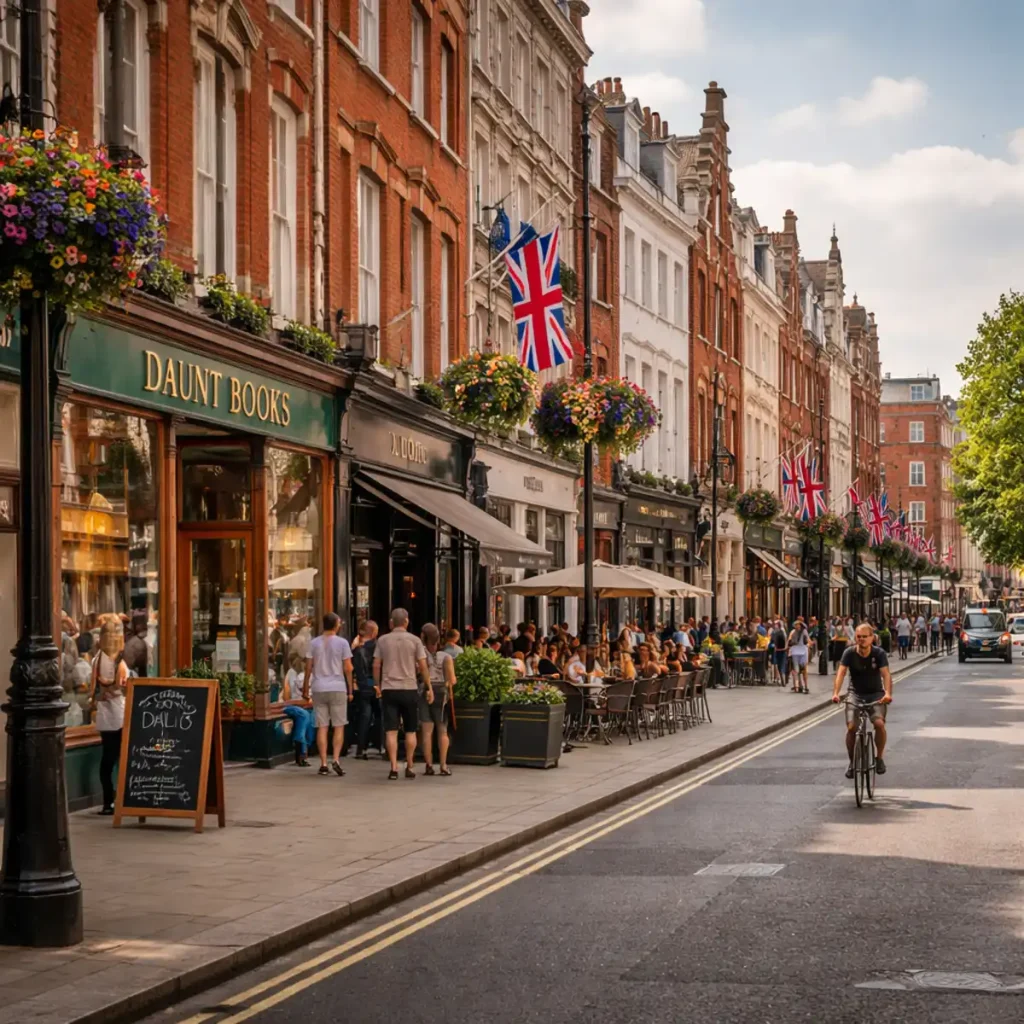
As 2026 begins, London is adjusting on both political and personal levels. Tax rules have changed, borrowing costs have settled after a rocky stretch, and employers are still deciding how often staff should come into the office. These factors have made people more cautious about housing. In many areas, this means a slower pace, with households and investors waiting to see what stability really looks like.
Marylebone is a useful exception because it shows what happens when demand is anchored in use rather than speculation. The neighbourhood concentrates services within walking distance, supports daily life without heavy reliance on cars, and benefits from long-term estate stewardship that has enabled curated change instead of piecemeal drift. It has also become a centre of the longevity economy, with Harley Street shifting from episodic treatment towards preventative health management. Based on the source material provided, the picture that emerges is of a place where property values, commercial vitality, and local identity reinforce one another.
Why 2026 Is A Turning Point For The Marylebone Property Market
Most forecasts for London in 2026 agree that the market is stabilising. Major consultancies expect slow growth, usually around 1-2% for the city, instead of a return to fast price increases. While this growth may seem small, it matters. The market seems to have absorbed the financial changes from 2024 and 2025, like the end of the non-dom tax regime and higher Stamp Duty Land Tax, and is now shifting from a pause to a more strategic phase.
Prime Central London has been described as trading materially below its 2014 peak, with a figure cited at around 20.7% under that high point as of late 2025. In some districts, that discount becomes the headline attraction. Marylebone benefits when confidence returns, but its demand is not built on bargain-hunting. Its appeal is tied to the scarcity of homes that fit how affluent Londoners are choosing to live, and to the neighbourhood’s ability to deliver a high density of everyday value.
A common claim in market commentary is that flats are expected to lag houses across London. Marylebone complicates that narrative because its most desirable homes are often flats that function like houses. Mansion blocks and lateral apartments offer scale, proportion and professional management, and they suit buyers who want centrality without the time costs of maintaining a townhouse. Freehold houses within the Georgian grid are limited, which channels demand into high-quality apartments rather than generic luxury stock.


How Owner Occupiers Are Reshaping Prime Central London Demand
Marylebone’s resilience is closely tied to who buys there, and why. In areas heavily reliant on international capital for asset parking, prices can respond sharply to policy and sentiment. The source material describes Marylebone as less exposed to those speculative flows and more supported by owner-occupiers purchasing a working life in London rather than a passive store of value. That distinction creates a stronger price floor because it is supported by both need and preference.
Research cited in the source material points to a shift towards owner-occupation in central London, rising from 54% to 64% of UK demand by 2025. Marylebone is positioned to capture that demand because it offers what owner-occupiers tend to prize. Schools, healthcare, retail, culture and green space are close enough to turn convenience into routine. The “village” effect is reinforced by a high street that still reads as a place for residents and visitors alike, and by a street network that rewards walking.
Demography strengthens the trend. The source material describes a rising share of buyers under 40, with 46% of central London buyers in that bracket by mid-2025, up from 34% in the prior decade. This younger wealth, often linked to technology, fintech and creative industries, is described as prioritising immediate lifestyle utility. Marylebone delivers that while remaining close to the West End, Soho and major transport nodes.
The “flight to quality” described in the source material is particularly evident here because supply is repeatedly described as tight for large, renovated homes. Buyers and renters are rejecting properties that require extensive modernisation, and favouring turnkey homes that work from day one. In Marylebone, the premium is increasingly paid for reliability, proportion, and well-run buildings, not for spectacle.
What The Prime Rental Surge Says About Risk And Flexibility
While Marylebone’s sales market in 2026 is steady, its rental market is marked by scarcity. The source material says that uncertainty in late 2025 led some potential buyers to rent instead, especially at the high end where flexibility is a luxury. In early 2025, rentals for homes over £1,000 per week rose by 154% compared to the previous year. This suggests that in 2026, demand will remain strong and competitive for homes offering privacy, quality, and good local access.
In Marylebone, competition focuses on certain features. Prime renters want spacious layouts, quiet streets, good building management, and quick access to the high street and services. These features are rare, which increases competition and keeps rental prices strong, even if property values are not rising quickly. For owners, this means holding onto properties can provide solid income while the broader market stays calm.
How The 15 Minute City Works In Practice On Marylebone Streets
The 15-minute city is often treated as a future planning project. In Marylebone, it reads as a description of how the area already functions. The Georgian grid compresses distances, and mixed use is a long-standing pattern rather than a new experiment. Residents can reach healthcare, retail, culture and green space with limited reliance on cars, and that proximity turns time into a measurable benefit.
Environmental efforts add to this effect. The Marylebone Low Emission Neighbourhood has grown over the past decade, with steps like diesel surcharges and anti-idling rules supported by ‘Air Quality Champions.’ The source material also mentions more electric vehicle charging, greener streets, and efforts to reduce delivery traffic. Cleaner air, less noise, and better pavements make walking the natural choice.
The economic significance is straightforward. When work patterns are unsettled and time feels scarce, neighbourhoods that reduce friction gain an advantage. Marylebone’s liveability is therefore not only an aesthetic argument. It is part of why demand can remain steady even as the wider city experiences cautious growth.
Fun fact: The Wallace Collection will host a major exhibition on Winston Churchill as a painter from May to November 2026, along with a free display about the museum during wartime from April to October 2026.
Oxford Street Pedestrianisation And The Fight Over Traffic Displacement
In 2026, Marylebone’s southern edge is changing as plans to transform Oxford Street move forward. The source material outlines a fast-tracked plan to pedestrianise Oxford Street West, from Orchard Street to Great Portland Street, led by a Mayoral Development Corporation. The goal is to remove private vehicles, buses, and taxis to make the area greener, with work set to move quickly for summer 2026.
For Marylebone, this change has both upsides and downsides. Taking traffic off Oxford Street could make nearby blocks quieter and cleaner. But if traffic is not managed well, it could lead to more congestion on other routes and more cars cutting through residential streets. The source material notes local worries about buses being rerouted to streets like Wigmore Street and Henrietta Place, and about taxis and other traffic moving into quieter parts of the area.
Mitigation measures described include timed access for service vehicles between midnight and 7 am, and wider crossings to manage pedestrian flows. Political friction is also described, including threats of legal challenge based on governance and accountability. In practical terms, the impact on Marylebone will depend on details that often decide the success of urban schemes. Routing, enforcement, loading provision, and traffic filtering will determine whether the scheme becomes a long-term uplift or a daily frustration.
Loxton Walk And The New Economics Of Independent Retail
Marylebone’s retail scene in 2026 shows how shopping streets can thrive when they are carefully managed, local, and focused on experiences. The source material says Marylebone High Street kept vacancies below 10% even during the pandemic, and has become a ‘third space’ where cafés, boutiques, and services are places to meet and return to, not just shop.
The Portman Estate and the Howard de Walden Estate are central to that resilience. Their approach is described as prioritising curation over credit score, backing tenants that add to the “village” ecosystem rather than defaulting to the highest bidder. In practice, that means fewer generic chains and more operators that fit the neighbourhood’s lived identity, whether in food, design, wellness or specialist retail.
Loxton Walk, set to open in early 2026, is an example of this approach. It links George Street, Blandford Street, and Baker Street with a pedestrian path and a courtyard for events and outdoor seating. The source material lists tenants that mix retail and leisure. Melrose & Morgan will have a 3,300 sq ft flagship for premium groceries. MATCHADO offers matcha as a wellness-focused alternative to regular coffee. Iris Avenue is a hybrid beauty salon and cocktail bar, combining grooming and socialising in one place.
Marylebone Square brings even more variety. Neko Health, described as an advanced health-tech body-scanning company co-founded by Spotify’s Daniel Ek, offers diagnostics next to boutiques. Circular fashion and design-focused brands are also present. The high street here does not try to match Oxford Street in size, but instead focuses on being relevant, encouraging repeat visits, and making shopping feel like a part of daily life.
Harley Street And The Rise Of The Longevity Economy
Harley Street remains one of London’s most recognisable medical addresses, but the source material describes a meaningful pivot by 2026. The district is shifting from episodic treatment towards preventative medicine, longevity, and the extension of health span. In this framing, health is a status marker, and the goal is not simply to live longer but to remain well for longer.
New infrastructure is driving this change. Hale House on Portland Place, fully open by June 2025, is described as a health-tech innovation hub created with the Howard de Walden Estate and Spacemade. The goal is to bring startups, investors, and researchers close to established medical experts, so new technologies stay connected to real-world practice.
The source material also mentions new models that mix clinical care with social activities. Arc is set to open in Marylebone in 2025-2026, focusing on contrast therapy. Hospitality is evolving too, with partnerships like Rebase at The Marylebone Hotel offering overnight retreats that combine comfort with advanced medical technology. Membership services, such as the Harley Street Longevity Club, provide concierge-style care, including genetic testing and biomarker analysis.
The spillover changes commercial property dynamics. High-covenant service operators are described as willing to pay premium rents of £100-£150 per square foot annually for prime locations. This supports commercial values while also reshaping the streetscape as clinics and specialised services displace traditional retail. Marylebone’s broader coherence depends on whether that shift remains balanced, and on whether estate curation continues to protect diversity of use.
Culture And Estate Stewardship Keep The Village Coherent
Marylebone’s durability in 2026 is not only a function of housing demand and well-being services. Culture keeps the neighbourhood from becoming a polished shell. The Wallace Collection is presented as a core anchor, with 2026 programming that includes both ticketed and free displays, and with a wider programme of investment intended to modernise visitor facilities. Wigmore Hall plays a parallel role, with its 125th anniversary season in 2025-2026 described as a major moment, including an anniversary festival in May and June 2026.
Festivals bring culture out into the streets. The Marylebone Summer Festival will close roads to traffic in June 2026, giving the community space for music, food, and social events. The St Marylebone Festival, from September 2025 to June 2026, uses the Parish Church for performances, including Rachmaninov’s Vespers in June 2026, keeping this historic building active as a community venue.
Underpinning these layers is the ownership model. The Portman Estate and the Howard de Walden Estate are described as long-term custodians that shape tenant mix and invest in streetscape improvements. Their influence is also evident in how local activism can affect outcomes, including the redesign of 38-70 Baker Street, described after concerns about scale. Stewardship, in this sense, is a mechanism for continuity. It makes the neighbourhood feel intentional rather than accidental, and that intention is part of what the market prices in.
What Marylebone 2026 Suggests For London’s Next Decade
Marylebone’s story in 2026 helps answer a bigger question about London’s resilience. The source material shows an area with steady market growth and strong underlying demand. More owner-occupiers help keep prices stable because they buy out of real need. Prime rental demand is high because flexibility matters more now. Retail works because it is carefully managed and focused on experience. The longevity economy draws investment and visitors. Cultural anchors keep the area socially connected, not just transactional.
Marylebone still faces risks. Pedestrianising Oxford Street could bring cleaner air or just move congestion elsewhere, depending on how it is managed. High service rents could reduce the variety of shops if careful curation slips. London’s affordability issues are still unsolved, and Marylebone’s success does not fix them. Still, as an example, it shows that neighbourhoods stay strong when they focus on essentials, support walkability, and invest in public spaces people use every day.
In 2026, Marylebone looks less like an enclave and more like a functioning model of dense urban life. It is like a well-rehearsed chamber ensemble inside a vast concert hall, small in footprint, precise in coordination, and influential beyond its size.