On Marylebone Lane, a short walk from Bond Street and Baker Street, a small, glass-fronted deli has become part of the daily routine for office workers, residents and food tourists. Ottolenghi Marylebone is not a sit-down restaurant with a wine list and lingering lunches. It is a compact deli and bakery, opened in July 2021, designed to move people through quickly while selling salads, pastries, breakfasts and branded pantry products at premium prices.
Unlicensed, almost entirely walk-in, and with around 9 seats at a single communal table, the site has turned into a crucial link in the Ottolenghi group, translating a global brand into an everyday lunch option for central London. As of early 2025, it is trading seven days a week, operating at full capacity and increasingly doubling as a catering hub for nearby businesses.
This report examines how the Marylebone deli works in practice: its footprint, operating hours, pricing, menu structure, supply chain decisions, customer experience and competitive pressures. It is based on public records, company announcements, job adverts, and consumer reviews, and is intended to give policymakers, professionals, and informed readers a clear view of how a high-profile food brand now operates on a tight central London site.
Ottolenghi Marylebone At A Glance
Ottolenghi's Marylebone outpost is designed as a high-velocity retail unit rather than a traditional restaurant, with every operational decision shaped by the building's constraints. The site at 63 to 65 Marylebone Lane, London W1U 2RA operates as a deli, bakery and retail shop, trading every day with a strict walk-in policy.
The dining room is tiny. Seating is effectively limited to a single communal table that can accommodate roughly 9 guests. There is no reservation system or online booking option, so every visit is speculative. For customers, this sets expectations before they arrive: this is somewhere to grab food, perhaps perch for a short time, but not to settle in for a long meeting.
The operating pattern reflects that brief. The deli opens at 08:00 from Monday to Saturday and closes at 19:00, with a slightly shorter day on Sunday, when it trades from 08:00 to 17:00. Morning hours focus on breakfast and coffee for residents and commuters. Late afternoon and early evening are geared toward take-home food such as salads, cakes, and breads for people living or working in the area.
Alcohol is absent by design. The site is unlicensed, which means no wine, beer, or cocktails for sale and no bring-your-own option. That single fact shapes dwell time, revenue mix and atmosphere more than any design decision.
Location And Marylebone Village Context
The Marylebone deli sits on Marylebone Lane, a narrow street that still traces the line of the old Tyburn River and feels very different to the nearby high street. While Marylebone High Street is lined with flagship shops, broad pavements and more obvious chains, the Lane is smaller in scale, with shops and cafes packed tightly together and sightlines that curve rather than run straight.
That geography matters. Ottolenghi is positioned in a section of the lane that links the residential streets of Marylebone Village with the denser retail and hotel cluster around Wigmore Street. It is roughly equidistant from Bond Street station on the Elizabeth, Jubilee and Central lines and from Baker Street. This means it sits inside a commuter catchment that runs from the West End offices into a wealthy residential enclave.
The neighbours reinforce its positioning. Around the corner, The Marylebone Hotel brings a steady flow of international guests looking for an "authentic London breakfast" outside the hotel dining room. Along the lane and on the nearby high street, high-end fashion, design, and lifestyle brands create a luxury cluster. Ottolenghi's bright salads and cakes in the window read as part of that landscape, not an interruption to it.
Fun fact Yotam Ottolenghi has described the Marylebone site as almost within throwing distance of his former London school, giving this branch a personal as well as commercial connection to the neighbourhood.
In practical terms, the combination of historic street pattern, affluent local residents and heavy visitor traffic makes Marylebone Lane an ideal showcase site. It gives the group a small but obvious stage on which to display the brand's food and books to a global passerby audience.
Accessibility And Inclusivity On A Compact Site
Despite occupying an older building on a tight plot, the Marylebone deli has been configured to meet modern accessibility expectations. For a national brand working in a central London conservation area, that is a non-negotiable requirement and a point of competitive differentiation.
The entrance from the street is step-free, allowing wheelchair users, people with mobility issues and families with buggies to enter without assistance. Inside, the deli offers a fully accessible ground-floor restroom, a rare feature among small cafes and grab-and-go sites in the area, many of which rely on basement or upstairs facilities that are harder to reach.
Menu design also aims for inclusivity. The group's longstanding emphasis on vegetables means that vegetarians are well served as a standard rather than an afterthought. Gluten-free options are prominent in the bakery case, such as flourless orange and almond cake and polenta-based bakes. Staff are trained to advise on allergens and ingredients.
At the same time, the open kitchen, shared work surfaces and close quarters service make complete control over cross-contamination difficult. For guests with severe allergies, the Marylebone format offers informed guidance but not the level of separation found in a specialist free-from operation.
Service Model And Licensing In Practice
Marylebone operates under a clearly defined deli service model that is consistent with the Ottolenghi brand but adapted to the site's constraints. Counter service is central. Guests order at the main counter, where salads and mains are displayed, and staff plate up the food rather than leaving customers to serve themselves.
The absence of an alcohol licence is more than a compliance footnote. Without wine or cocktails, there is no incentive for diners to linger beyond the time needed to eat. The result is a natural cap on dwell time, typically in the 30 to 45 minute range for those who do secure a seat. For a venue with only one communal table, this rapid rotation is commercially useful, ensuring that the few chairs do not become locked up by long, drink-led lunches.
The unlicensed status also subtly shapes the occasion. In contrast with Ottolenghi's restaurants in Fitzrovia and Soho, which trade heavily in evening bookings and date nights, Marylebone feels more like a functional food stop. It is somewhere to eat well and move on rather than somewhere to mark an anniversary. That positioning sits comfortably in a neighbourhood where there are many other licensed options within a five-minute walk.
Who Uses Ottolenghi Marylebone
Customer patterns at Ottolenghi Marylebone split clearly between the working week and weekends. In office hours, particularly between 11:30 and 14:00, the queue is dominated by people who work locally. That includes staff from hedge funds and professional services firms based between Marylebone and Mayfair, as well as clinicians and administrators from nearby Harley Street medical practices.
For this weekday crowd, time is the scarce resource. Many are relatively price-insensitive but unwilling to take a full hour away from their desks. A plate of salads and a main that costs more than £20 is accepted if it is quick, flavour-packed and cannot easily be reproduced at home. The deli becomes a kind of premium canteen for the West End workforce.
On Saturdays and Sundays, the balance shifts. Families from the surrounding streets, often with children and buggies, join hotel guests and international visitors who know the Ottolenghi name from cookbooks or television. These customers are more likely to attempt to sit at the communal table, turning a salad plate into a leisurely late breakfast or early lunch.
The physical constraints of the building make queuing a central part of the experience. Lines frequently spill onto the pavement during peak periods. For some, this visible demand functions as social proof that justifies the cost and confirms that they have picked the right place. For others, it is a deterrent, sending them further down the lane to competitors with more space or faster throughput.
Menu Architecture From Breakfast To Salads
The Marylebone menu has been engineered to offer high average spend within a tight footprint and limited kitchen capacity. It is structured in two main phases across the day: a focused breakfast service and a counter-led lunch built around salads and mains.
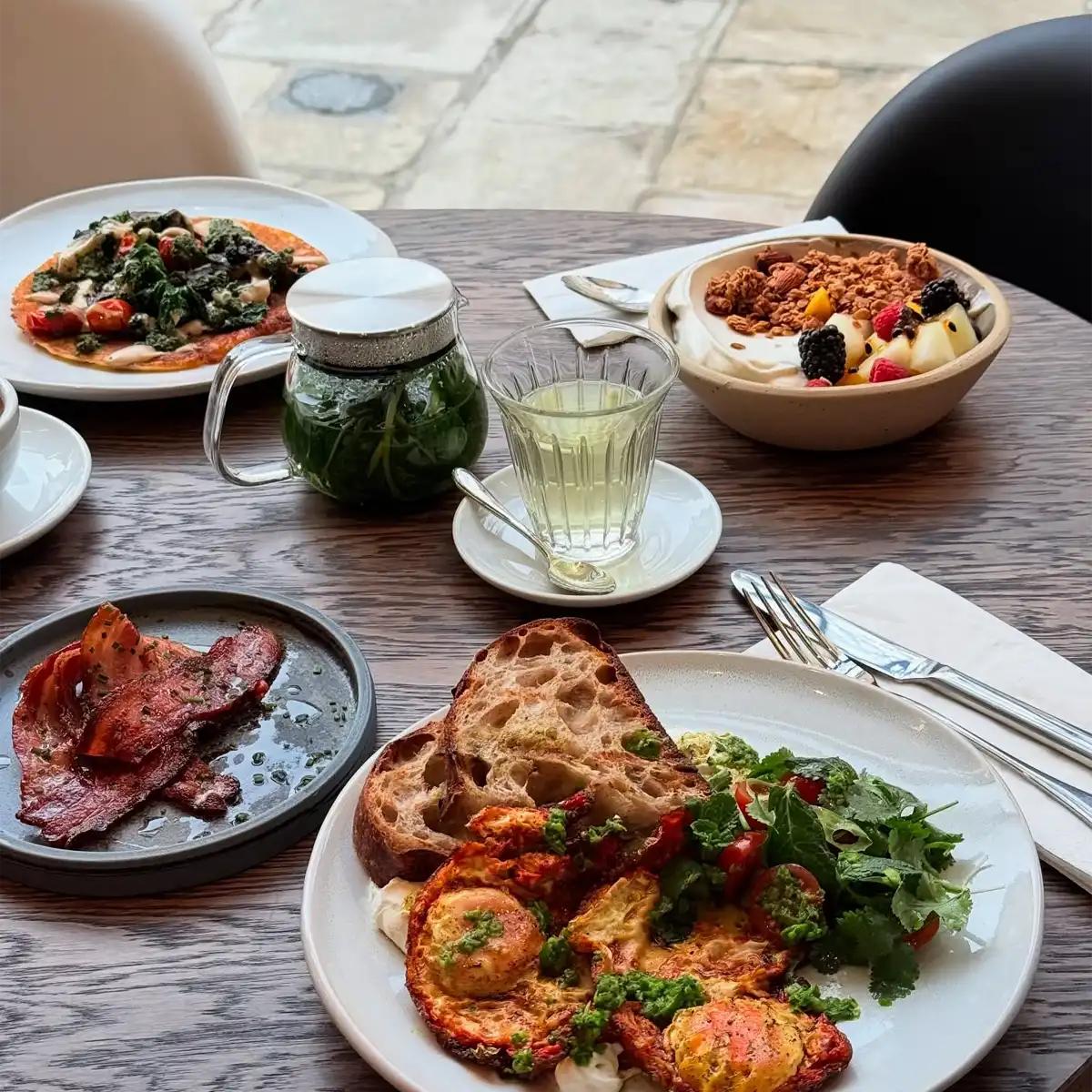
Breakfast is concise and premium. Rather than a sprawling brunch lineup, the menu features a short list of dishes that require skilled preparation but are still quick to send. Variations on eggs dominate. Shakshuka, with braised eggs, labneh and grilled focaccia, sits alongside scrambled eggs with Smokin' Brothers smoked salmon, and turmeric-spiced eggs with labneh, grilled sourdough and tomatoes. Prices in early 2025 position these plates firmly at the upper end of London's casual breakfast market, with the salmon option at around £16.50 and other egg dishes only slightly lower.
Alongside the hot dishes, a tight selection of pastries underpins the morning trade. Croissants and pains au chocolat typically sit around £4.70-£5, making them some of the more expensive Viennoiserie items in the capital, but aligning with the brand's image and the local customer base.
From late morning, the focus shifts to the salad counter, a central feature of every Ottolenghi deli. Large platters of salads are laid out at room temperature, framed by warm mains that are cooked and held behind the glass. The food looks self service yet remains staff-served, a model that allows for portion control and reduces waste.
The pricing structure encourages spending. A typical plate pairs a warm main with two or three salads. In 2024 and early 2025, a main with two salads is priced at £25, rising to £28.50 with three salads. A vegetarian plate of three salads alone costs £20.50. For many office workers, this is a significant outlay for a mid-week lunch. Yet, it buys variety and labour: several different preparations in one box, each involving chopping, roasting, seasoning and garnishing.
Proteins tend to be familiar yet precise. A char-grilled salmon dish uses fish from Loch Duart in Scotland and may be paired with preserved lemon and coriander yoghurt. Roast chicken is marinated in shawarma-spiced yoghurt. A pork hambagu kofta nods both to Middle Eastern meatballs and to Japanese homestyle patties.
The salads follow recognisable Ottolenghi archetypes. One bowl might use roasted pumpkin dressed with date tahini. Another might combine char-grilled broccoli with chilli and garlic. A third could layer roasted aubergine with spiced mung beans. Tahini, za'atar and pomegranate molasses appear frequently, adding richness and acidity but also helping the food hold well at ambient temperature through the busy lunch period.
Pastry Counter And Retail Wall Strategy
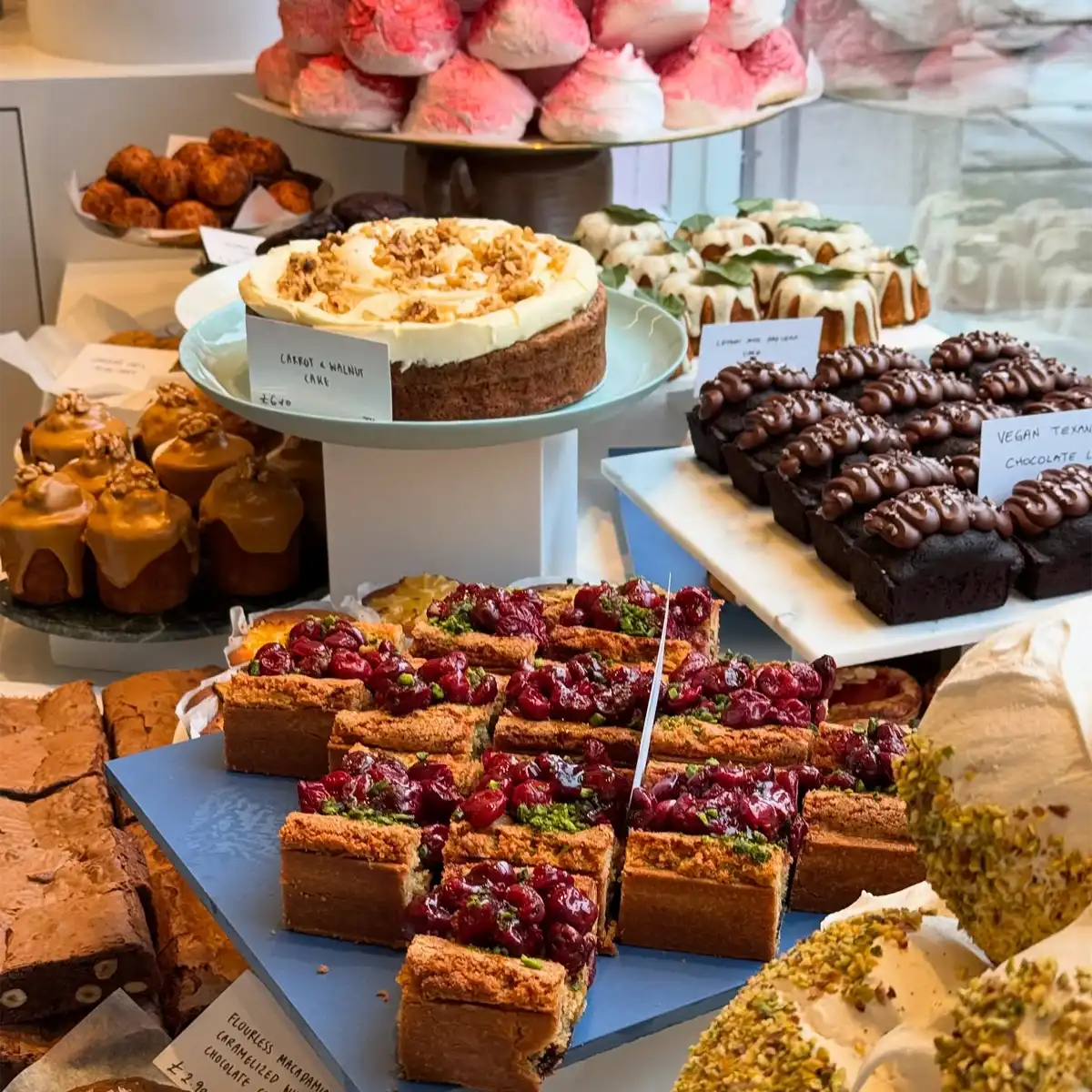
If the salad counter feeds the local workforce, the pastry display and retail shelves speak directly to passersby and home cooks. The front window is dominated by giant meringues, piled high and streaked with vivid colours. These have become an informal signature of the brand and a visual hook for social media, with a price point around £4.
Behind the glass, the cake selection balances indulgence with dietary inclusion. A vegan cake of the day sits alongside dense slices such as flourless orange and almond cake, which is both gluten-free and rich enough to justify a price over £7 per portion. For the Marylebone professional picking up something for an afternoon meeting or a dinner party, this offers a low-effort way to arrive with something recognisable and impressive.
Running along the walls, shelves of Ottolenghi cookbooks and pantry items turn the deli into a retail showroom. Titles such as Plenty, Simple, Flavour and Ottolenghi Test Kitchen volumes like Shelf Love are stacked visibly. Nearby, jars of dukkah, rose harissa, and preserved lemons invite customers to attempt some of the flavours at home.
This merchandising is not a side thought. It allows the group to cross-sell from food to books and packaged goods, reinforcing the brand in several parts of a customer's life at once. For visiting tourists, buying a book or jar is a way to take a piece of Ottolenghi Marylebone home. For locals, it is a reminder of recipes that keep the brand top of mind between visits.
Supply Chain Sustainability And Provenance
The Marylebone deli benefits from the wider group's investment in sourcing and sustainability, which has intensified in the last few years. Ingredient provenance is used both as a quality marker and as a story to justify higher prices.
On the menu, suppliers are named in a level of detail more often associated with fine dining. Fresh salmon is specified as coming from Loch Duart, a Scottish producer known for welfare-focused farming. Smoked salmon used at breakfast is attributed to Smokin' Brothers, a Gloucestershire-based smokehouse whose thicker-sliced product is favoured over more industrial alternatives.
Drinks follow a similar pattern. Bottled water is supplied by Hildon in Hampshire. Cold-pressed juices come from Daily Dose, a London company that works with surplus and "wonky" fruit to reduce waste. Kombucha is sourced from You + I, a small producer specialising in oak fermented, organic batches, while sparkling iced tea is supplied by Marna.
At the group level, Ottolenghi has deepened partnerships with farms such as Piper's Farm and Lincolnshire Game, reflecting a broader shift towards regenerative agriculture. While much of this work was piloted at the restaurant ROVI, the supply chains established there feed into the deli network, including Marylebone. For customers at the salad counter, this shows that the meat and game behind the glass come from farms actively promoted as ethical and environmentally conscious.
The influence of the Ottolenghi Test Kitchen (OTK) in Holloway is also visible. Recipes developed and published in the OTK book series frequently appear on the deli counter, creating a loop in which customers can eat a dish, see the book containing its recipe, and then buy both in a single visit.
Queue Economy And Customer Experience
For many visitors, the dominant impression of Ottolenghi Marylebone is the queue. At peak times, particularly between midday and 13:30 on weekdays, the line can extend out of the door and along the pavement. This is the predictable outcome of a strong brand operating in a small space, but it has important consequences for customer perception.
Reviews and informal feedback reveal a split view. The food is widely praised, with repeated references to the depth of flavour, the way spices are used and the generosity of portions. The combination of several salads and a main in one box creates a sense of abundance that helps offset the impact of the bill.
Service, by contrast, attracts more criticism. The pressure on the counter team to move orders along quickly in cramped conditions has led some customers to describe interactions as abrupt or even rude. Complaints about staff attitude, crowding and a sense of being rushed recur in online commentary. In effect, the site struggles with its own success, delivering high-quality food but finding it harder to sustain hospitality standards at busy times.
Pricing sits at the top end of the fast casual bracket, with a typical takeaway salad and main lunch costing over £20. Yet the demand curve has so far remained relatively firm. For the core customer base of time-poor, well-paid professionals, the cost is balanced against the effort required to shop, chop and cook several different vegetable-based dishes at home. When that labour is factored in, the purchase can be framed as a rational trade-off rather than an indulgence.
Competition Across Marylebone Village
Ottolenghi does not operate in isolation. Marylebone Village has a dense and well-established food scene, and the deli competes directly and indirectly with several notable operators for the same daytime spend.
On Marylebone Lane itself, Lina Stores offers fresh pasta at a similar price point, with the added benefit of a full alcohol licence and more comfortable counter seating. For diners who have the time to sit down properly and want a glass of wine with lunch, Lina Stores offers an experience that Ottolenghi's Marylebone deli, by design, cannot match.
Around the corner, The Italian Greyhound offers a more relaxed, full-service restaurant setting with a terrace. It attracts both business lunches and social gatherings that call for table service and drinks, again occupying a space that the unlicensed, communal table deli cannot easily contest.
On Marylebone High Street, Daylesford Organic competes for the same health-conscious, premium takeaway market, combining groceries, cafe seating, and hampers under one roof. Further along the spectrum, Fischer's offers a Viennese-style cafe experience aimed at traditional Marylebone residents and visitors seeking a slower, grander environment.
Even The Marylebone Hotel itself is a competitor at breakfast, as it works to retain guests inside its own dining rooms rather than seeing them walk across the street to Ottolenghi.
In this context, the deli's main competitive advantages lie in its vegetable variety, the global recognition of the Ottolenghi name and the very visible theatre of its salad and pastry displays. It is often the default choice for visitors who identify as "foodies", as well as for locals who want something lighter and more plant-focused than a plate of pasta or a large cooked breakfast.
Staffing Strategy And Catering Pivot
Behind the counter and kitchen at Marylebone, staffing decisions are being shaped by wider changes in the Ottolenghi group. Over the last 18 months, the company has moved to centralise more of its culinary leadership and to use individual sites more strategically.
In late 2024, Neil Campbell, formerly head chef at ROVI, was promoted to Executive Chef across the group. This shift signals an effort to standardise quality, technique, and menu development from the top, ensuring that ideas tested in one part of the business can be rolled out reliably across the rest. For Marylebone, that means access to dishes and processes developed in the larger restaurants and in the test kitchen, fitted into a deli format.
At the start of 2025, job advertisements for a Site Catering Manager and Office Support role specifically linked to Marylebone suggested a further evolution. The role description indicated that the site would act as a base for expanding the group's corporate catering offer in the immediate area.
The logic is clear. With limited seats front of house but a fully operational kitchen, Marylebone is well placed to supply boardroom lunches and event platters to nearby offices and clinics. This allows the group to increase revenue per square metre without squeezing more seats into the already tight public space. It effectively treats the deli not only as a shop and cafe but also as a satellite production unit for the West End.
Risks, Pressures And Long-Term Outlook
For all its success, Ottolenghi Marylebone carries several operational and reputational risks that are worth noting for planners, neighbours and potential imitators.
The first is service culture under pressure. Persistent reports of brusque or unfriendly interactions, even if they reflect only a proportion of visits, can chip away at a brand that has built its reputation on warmth as much as on flavour. In a setting where staff are working at high speed in a confined environment, finding ways to maintain calm, clear communication with customers is both a human resources challenge and a brand protection issue.
The second is the physical impact of queuing on the street. Marylebone has active resident associations, and concerns about pavement congestion, prams and crowds outside popular venues are a regular theme in local discussions. While there is no public record of a planning dispute specific to the deli at the time of writing, its success undeniably contributes to peak-time pressure on the lane.
The no-reservations policy, central to the deli's walk-in identity, also cuts both ways. It creates a sense of spontaneity and keeps throughput flexible, but it makes the venue difficult to use for business meetings or time-sensitive gatherings. In those cases, diners are likely to opt for competitors where a table can be secured in advance.
At the same time, the Marylebone site has firmly established itself as part of the neighbourhood's food infrastructure. It functions as a premium canteen for local workers, a reliable source of cakes and salads for residents and a pilgrimage point for visitors who know the Ottolenghi brand from media and books.
Looking ahead, the most significant development is the quiet pivot towards corporate catering and off-site sales. By turning the Marylebone kitchen into a hub for nearby offices while maintaining its retail and deli offer, the group is trying to decouple revenue growth from the physical limits of the building. That strategy is mirrored in its broader expansion, from new sites in Richmond to international openings in cities such as Geneva.
The central challenge will be to preserve the sense of craft and individuality that has defined Ottolenghi's food while operating at a scale that now includes books, retail products, restaurants, delis and a growing catering arm. In Marylebone, that tension is concentrated into a few dozen square metres of glass, steel and shared table space, where the salad counter still feels personal even as it serves a constant line.
For policymakers and urban planners watching the evolution of central London's hospitality scene, Ottolenghi Marylebone offers a useful case study. It shows how a high-profile food brand uses a very small site to blend retail, fast casual dining and off-site catering, relying on queues and visual impact as much as on traditional restaurant metrics. In a neighbourhood that often resembles a carefully furnished drawing room, the deli operates more like a well-drilled canteen line, working hard to keep both its pace and its personality intact.
Continue Reading
The Marylebone Gazette
Delivered weekly to your inbox
Subscribe for the latest from Marylebone.