Santo Remedio Marylebone has opened on Thayer Street with a clear ambition, positioning itself as a serious benchmark for regional Mexican cuisine in central London rather than a novelty or street food pastiche. The third site from founders Edson Diaz-Fuentes and Natalie Feary aims squarely at the middle of the market, sitting between fast-casual concepts and the rarefied world of tasting-menu fine dining, and, in doing so, is reshaping how the capital understands Mexican food.
For policymakers, hospitality investors and diners alike, the restaurant offers a case study in how a tightly defined culinary identity, a thoughtful design language and a disciplined operational model can support a sustainable, mid-priced business in one of the country’s most competitive neighbourhoods. At the same time, the venue functions as a cultural bridge, giving British guests access to dishes, techniques and ingredients that have long been underrepresented in the UK.
Inside The Founders’ Story And Brand Evolution
Santo Remedio’s trajectory from a modest London pop-up to a Marylebone restaurant with serious architectural and gastronomic ambition is inseparable from the biographies of its founders. Chef Edson Diaz-Fuentes, raised in Mexico City, grew up in markets where ingredients are sourced with almost forensic precision. Specific stalls are trusted for particular chillies, herbs or cuts of meat, and that early education in provenance runs throughout the current menu, from nixtamalised tortillas to mole built from carefully layered spices and fruits.
His professional discipline was strengthened in Oaxaca City at Casa Oaxaca, under chef Alejandro Ruiz, whose influence can be read clearly in Santo Remedio’s insistence on slow cooking, multi-day preparations and a refusal to dilute traditional recipes purely for convenience. Before arriving in London in 2014, Diaz-Fuentes also spent time in New York, where a more mature Mexican dining culture offered a template for how serious regional cooking could succeed in a global city.
If Diaz-Fuentes provides the culinary direction, co-founder Natalie Feary has been key to turning that vision into a resilient business. Early experiments as a pop-up gave way to a small Shoreditch site, then a larger London Bridge restaurant focused on wood-fired cooking. Along the way, the pair navigated a forced closure due to building issues and turned to their community to crowdfund a relaunch. That episode gave Santo Remedio a loyal core audience and a level of emotional connection that is hard to manufacture in corporate hospitality groups.
The current portfolio reflects a deliberate strategy rather than simple expansion. Shoreditch operates as a busy taqueria with relatively sharp pricing and rapid turnover. London Bridge leans into the asador model, built around charcoal and big cuts of meat. Santo Remedio Marylebone is the most polished version yet, conceived as a home-like space where guests are encouraged to linger over sharing plates, cocktails and bottles of Mexican wine.
What The Casona Design Means For Diners
The Marylebone site is presented as a Casona and Cantina, drawing on the grand early 20th-century houses of Mexico City’s Roma, Juárez and Condesa districts. In those neighbourhoods, large homes were typically designed for entertaining, with high ceilings, separate rooms for different activities, and a fluid transition between semi-public and private areas. Santo Remedio takes that domestic blueprint and translates it to a London restaurant, in deliberate contrast to the stripped-back industrial interiors that have dominated the city’s dining scene in recent years.
Designed with Parallel Projects, the space is divided across two levels. At street level, the ground-floor cantina operates as the social engine of the building, with an open bar in patchwork marble and reclaimed stone, big windows to Thayer Street and an atmosphere that fits everything from a quick cocktail to a full dinner. Upstairs, Salón Santo functions more like a living room, with softer seating, its own bar and an acoustic profile better suited to lingering conversations, small celebrations or semi-private events. A separate private dining room, Mesa Santa, is styled as a self-contained domestic dining space, giving companies and families a room that feels less like a boardroom and more like a home.
Colour and craft are used to emphasise the Mexican reference points without slipping into cliché. Walls in sandy neutrals and terracotta tones echo adobe and old stucco, while decor includes handwoven pieces bought directly from artisans in Mexico City. Handmade tiles by British artist Frea Buckler extend the cross-continent collaboration, underlining that this is a Mexican restaurant firmly rooted in a London postcode. Warm amber lighting and rice paper shades give the interior a relaxed 1970s inflexion that connects it to current design trends and to Mexico City’s long relationship with mid-century style.
Where Santo Remedio Sits In Marylebone’s Mexican Cluster
Marylebone has quietly become the most concentrated area for upscale Mexican restaurants in London, and Santo Remedio’s arrival completes a three-part ecosystem. On Seymour Street, Kol offers a Michelin-starred, experimental take on Mexican-inspired cooking, built largely on British ingredients, at prices that place it firmly in the special-occasion bracket. Nearby on Wigmore Street, Cavita focuses on open fire cooking and a sophisticated dinner trade, again at a premium price point.
On Thayer Street, Santo Remedio Marylebone has chosen a different economic niche. With typical spend in the £45 to £70 range, it is consciously positioned as an accessible Mexican restaurant in Marylebone, able to host a Tuesday business lunch, a pre-theatre dinner or a sociable weekend brunch without requiring months of advance planning. In doing so, it reduces direct competition with its neighbours. Instead, it broadens the audience for serious Mexican cooking in W1, supporting the idea that a full spectrum of price points is essential if London is to sustain a diverse dining culture.
The address at 13–14 Thayer Street has previously hosted high-end concepts that struggled to find long-term traction, underscoring the site’s commercial challenges. Santo Remedio’s established brand recognition, broader price band and flexible use of space give it a better chance of riding out Marylebone’s high fixed costs than a more narrowly focused fine dining operation.
How The Menu Showcases Regional Mexican Cooking
The food offer at Santo Remedio is best understood as a tour of micro regions rather than a catch-all of generic Mexican dishes. Dishes from Oaxaca, Veracruz, Puebla, the Yucatán peninsula and Baja California each have space on the menu, and their specific histories are reflected in both technique and sourcing.
The cornerstone is corn. Instead of relying on industrial flour, the kitchen works with heirloom purple corn supplied by MasaFina and carries out nixtamalisation on site, soaking the kernels in an alkaline solution before grinding. This ancestral process not only improves flavour and texture, giving tortillas and tostadas a nutty depth and pliable bite, but also boosts nutritional value by unlocking niacin. For diners, one practical outcome is that the taco and tostada sections of the menu are naturally gluten-free, which is a meaningful point of difference in a health-conscious neighbourhood.
Starters reinterpret classic antojitos, or little cravings, often associated with markets and street corners. A bowl of guacamole can be upgraded with chapulines, or grasshoppers, flown in from Oaxaca, fried with chilli and lime. The result is a crunchy, intensely savoury garnish that recalls both dried seafood and salt-and-vinegar crisps, introducing insect protein in a playful yet respectful way. Tuna tostadas nod to Baja’s coastal cooking, pairing sashimi grade fish marinated in tamari and ancho with chipotle mayonnaise and crisp shallots. This combination quietly acknowledges the Japanese influence on the region’s fishing communities. Empanadas made from corn dough filled with chorizo and cheese reference familiar Central Mexican snacks, but benefit from the kitchen’s commitment to heirloom masa.
Main dishes move away from handheld formats to the slower, stew-driven rhythm of traditional home cooking. A slow-cooked short rib served in mole Xiqueño from Veracruz is the centrepiece, braised until the meat can be taken with a spoon and cloaked in a sauce built from dried fruits, nuts, chillies and chocolate. The portioning is designed to be shared, reinforcing the Casona’s family-style dining theme. Duck carnitas adapts the pork confit of Michoacán to a richer bird, matching its fattiness with the sharpness of salsa verde. Whole seabass a la talla is split and marinated in two different adobos, one green and herb-driven, the other red and chilli-led, allowing diners to experience contrasting profiles on a single fish.
Fun fact: Nebbiolo vines planted in Baja California are thought to have diverged from their Italian cousins decades ago, producing Mexican wines with deeper colour and riper fruit character than many European examples.
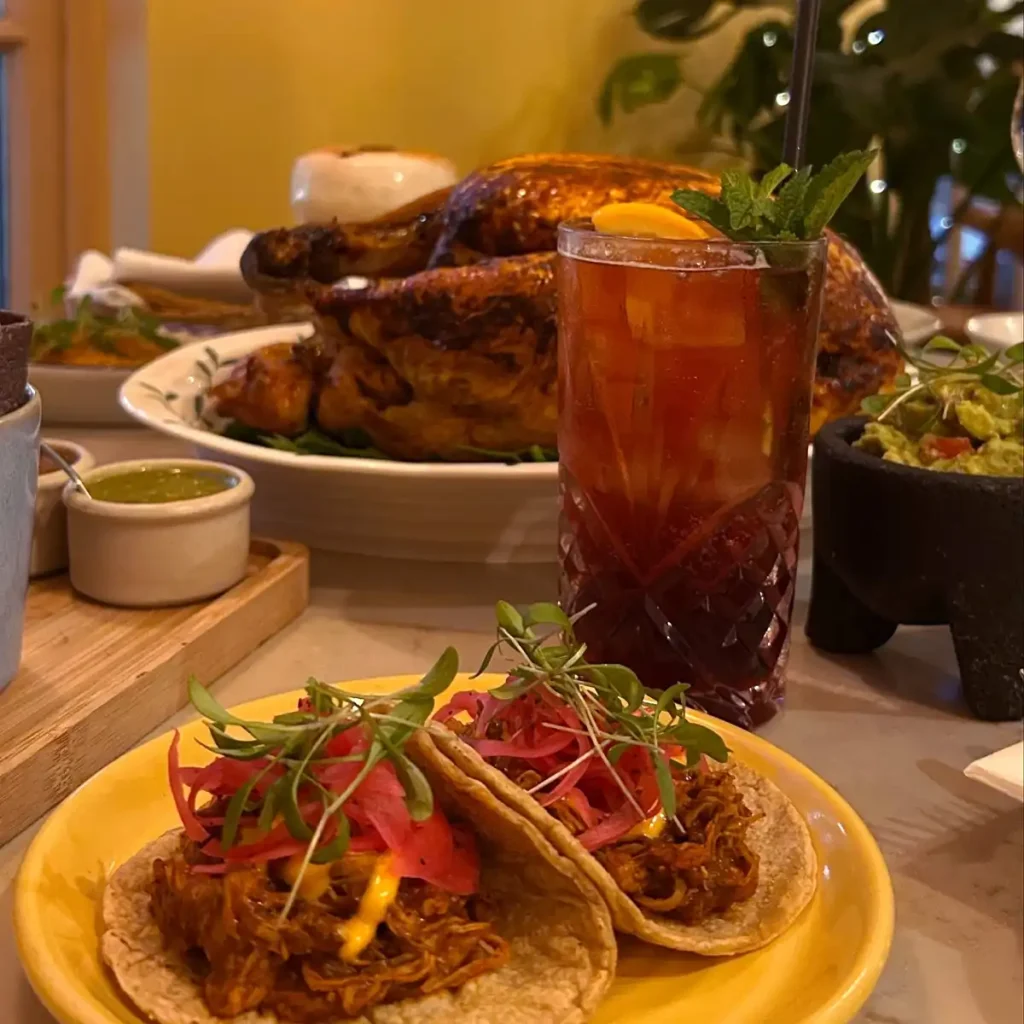
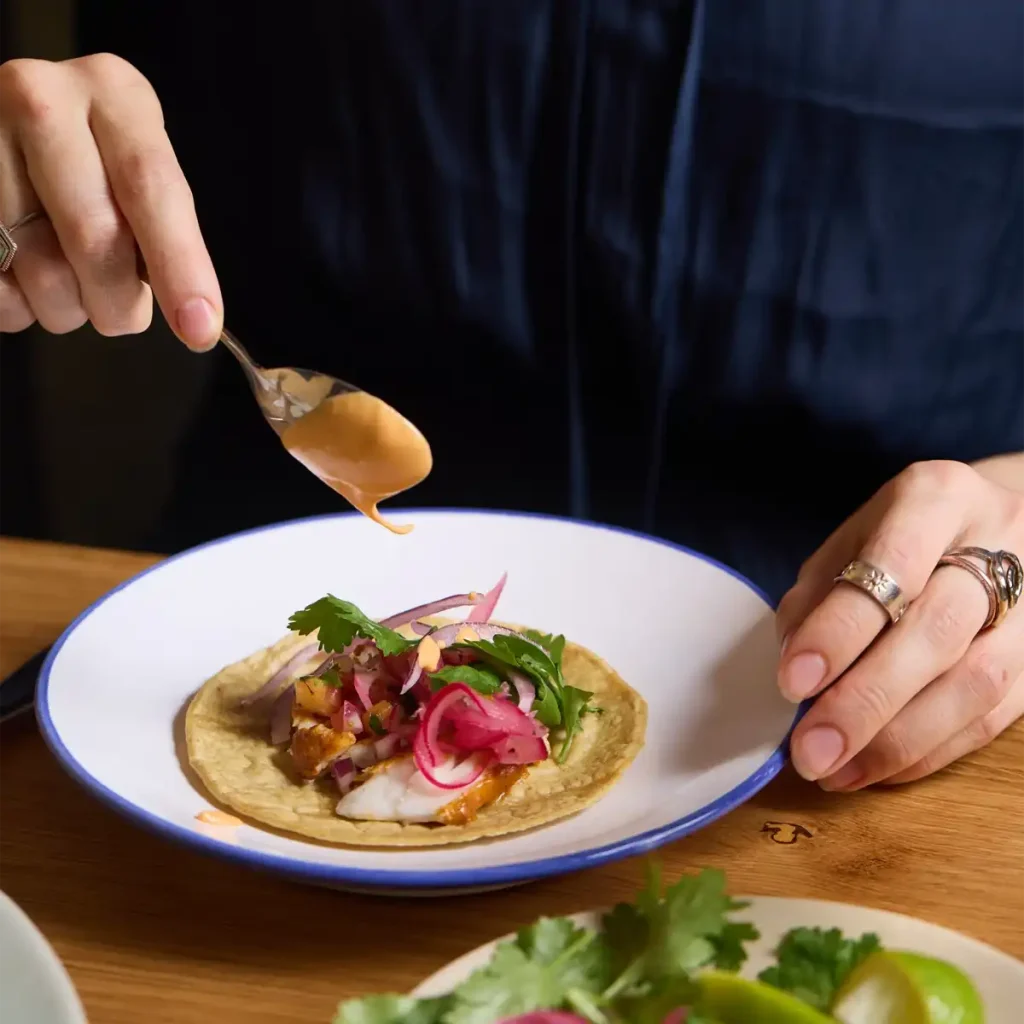
Tacos are treated with similar seriousness. Baja-style fish tacos rely on a batter made with gluten-free beer and tequila to produce a light, brittle shell around the hot fish, offset by crisp cabbage and smoky chipotle sauce. Soft shell crab arrives in an achiote-tinted crust, the annatto seeds lending earthiness and a vivid colour that plays well against the crab’s sweetness.
Brunch, which has become a key part of the London hospitality economy, is used to introduce dishes still unfamiliar to many British diners. Huevos motuleños stack fried tortillas, beans, eggs, salsa, ham, peas, cheese and fried plantain into a single plate that shows how sweet and savoury notes coexist in Yucatán cooking. Chilaquiles, a comfort dish of chips simmered in salsa until just softened, then topped with crema and cheese, are offered in both red and green variants, broadening the popular understanding of what a Mexican breakfast can look like.
Why The Drinks List Matters For Agave And Mexican Wine
The drinks programme at Santo Remedio Marylebone is conceived to stand on equal footing with the food. The bar treats Mexico’s agave spirits as an opportunity for education as much as for refreshment, and the list is structured to guide guests beyond the simple tequila versus mezcal distinction into questions of species, terroir and sustainability.
Entry-level pours introduce Espadín-based mezcals from Oaxaca, with familiar smoky, fruity notes. Alongside them sit bottlings from wild species such as Cenizo from Durango, Tobalá from the highlands of Puebla and Oaxaca, and Cupreata from Guerrero, each with a distinct character. The menu makes clear that these wild plants can take more than a decade to mature and are difficult to cultivate, which explains their higher prices and underscores the environmental stakes involved in their production. In doing so, the restaurant positions itself as a serious stop for agave enthusiasts in London, not merely a place to drink margaritas.
The wine list pushes equally hard to showcase Mexico’s potential. Labels from the Valle de Guadalupe in Baja California, including well known producer L A Cetto, demonstrate how Cabernet Sauvignon and Nebbiolo behave in a Mediterranean-like climate with strong sun and limited rainfall. A Mexican Nebbiolo on the list is noted for its darker, more fruit-driven profile than many European examples, a reminder that grape names do not always signal identical flavour from one continent to another. White wines, including Sauvignon Blanc from Baja, bring tropical notes quite unlike the grassiness associated with New Zealand or the mineral edge of the Loire, helping the restaurant challenge established reference points for British wine drinkers.
Cocktails balance commercial necessity with regional character. Margaritas appear in several guises, but the menu also includes drinks such as a savoury mezcalita verde built on jalapeño, citrus and herbs, aligning with Londoners’ taste for vegetable-based juices. The carajillo, a shaken mix of Licor 43 and espresso popular in Mexico City as an after-dinner drink, anchors the digestif section and is well placed to grow in prominence among London’s cocktail culture.
How The Business Model Targets Accessible Luxury Diners
Behind the scenes, Santo Remedio operates with the kind of infrastructure more often associated with larger groups. A modern EPOS system and kitchen display screens help coordinate service between two floors and multiple bars, particularly during peak brunch periods when food and drink orders surge simultaneously. For observers of the sector, the site illustrates how independent operators are increasingly required to adopt enterprise-level technology to meet guest expectations on speed and accuracy.
Commercially, the bottomless brunch offer is structured as a yield management tool rather than a discount. A time limit and the requirement to order substantial food discourage very low spend visits, keeping average bills in the £50 to £60 range while incentivising bookings in daytime slots that might otherwise be quieter. By including Mexican wines and sangria as part of the package, the restaurant can lean on items with a lower cost of goods than strong cocktails, smoothing margins without compromising perceived value.
The building’s zoning further supports revenue diversification. While the main dining areas cater to regular trade, the private dining room and first-floor salon enable higher-spending corporate events, brand takeovers, and family celebrations to run concurrently. In a postcode where rent is among the highest in the country, the ability to generate several streams of income at once is fundamental to long-term viability.
What Critics And Guests Really Say So Far
Early professional reviews have converged around two themes: a sense of authentic Mexican hospitality and a feeling that Santo Remedio is easy to recommend. Food writers have praised generous tacos, carefully judged guacamole and ceviches that balance acidity and freshness with confidence. Design-focused publications have highlighted the interior as somewhere that feels like visiting a friend’s well-put-together home, confirming that the Casona concept translates effectively to a British audience.
Guest feedback on booking platforms broadly aligns with that critical reception. Comments frequently reference authenticity, a warm and lively atmosphere and notably friendly service. These patterns matter in a crowded London dining market, where word of mouth and repeat custom are still central to survival. Some diners, however, note that portions can feel modest for the price, a recurring tension in labour-intensive cuisines where the amount of work in a dish is not always immediately visible on the plate. Noise levels are also mentioned, with the energetic ground floor ambience that suits groups and celebrations occasionally challenging for those seeking a quiet conversation.
What Santo Remedio Signals For Mexican Food In Britain
Taken together, Santo Remedio Marylebone represents a pivotal moment in the story of Mexican food in Britain. It moves the conversation beyond burritos and Tex-Mex excess into a more nuanced appreciation of regional dishes, indigenous ingredients, and the social rituals of Mexican dining, while remaining accessible enough for regular visits. For policymakers and local authorities concerned with the future of high streets, it offers evidence that culturally specific, independently run venues can anchor a neighbourhood’s identity and draw a broad demographic when they combine rigour with warmth.
As the Mexican cluster around Marylebone matures, Santo Remedio sits not as an isolated temple of gastronomy but as a lived-in home at the centre of the action. The restaurant shows that authenticity can be commercially viable when supported by thoughtful design, resilient operations, and a clear understanding of its audience. In that sense, the project resembles a carefully built mole, where diverse ingredients are ground together over time into something greater than the sum of its parts, leaving a lasting flavour on the city’s culinary memory.