Premium customer experience used to mean elegant design, fast service, personal attention and fewer points of friction. All of that still matters. However, something else has moved into the centre of the customer relationship: digital trust.
For premium brands, trust is no longer just a background requirement. It is part of how the product feels. Customers want a smooth journey, but they also want proof that their data is handled responsibly, transactions are protected, communications are authentic and the brand is not careless with its digital environment.
What Digital Trust Means for Premium Brands
Digital trust is the customer’s belief that a brand can protect sensitive data, maintain honest interactions and deliver a safe digital experience. It brings together privacy, cybersecurity, fraud prevention, transparency, identity protection and dependable communication.
For premium customers, this expectation is even more acute. They are not only paying for a product or service. They are paying for confidence. The payment page should feel stable and secure. The loyalty account needs protection. A tailored offer should not feel intrusive or excessive. Customer support should know enough to help, but not so much that the whole flow feels uncomfortable.
McKinsey has argued that consumers value digital trust and may take their business elsewhere when companies do not meet expectations around cybersecurity, data protection and responsible digital behaviour. That idea is especially relevant for premium brands, where the relationship is often built on discretion and reliability.


Why Trust Became One of the Strongest Customer Experience Signals
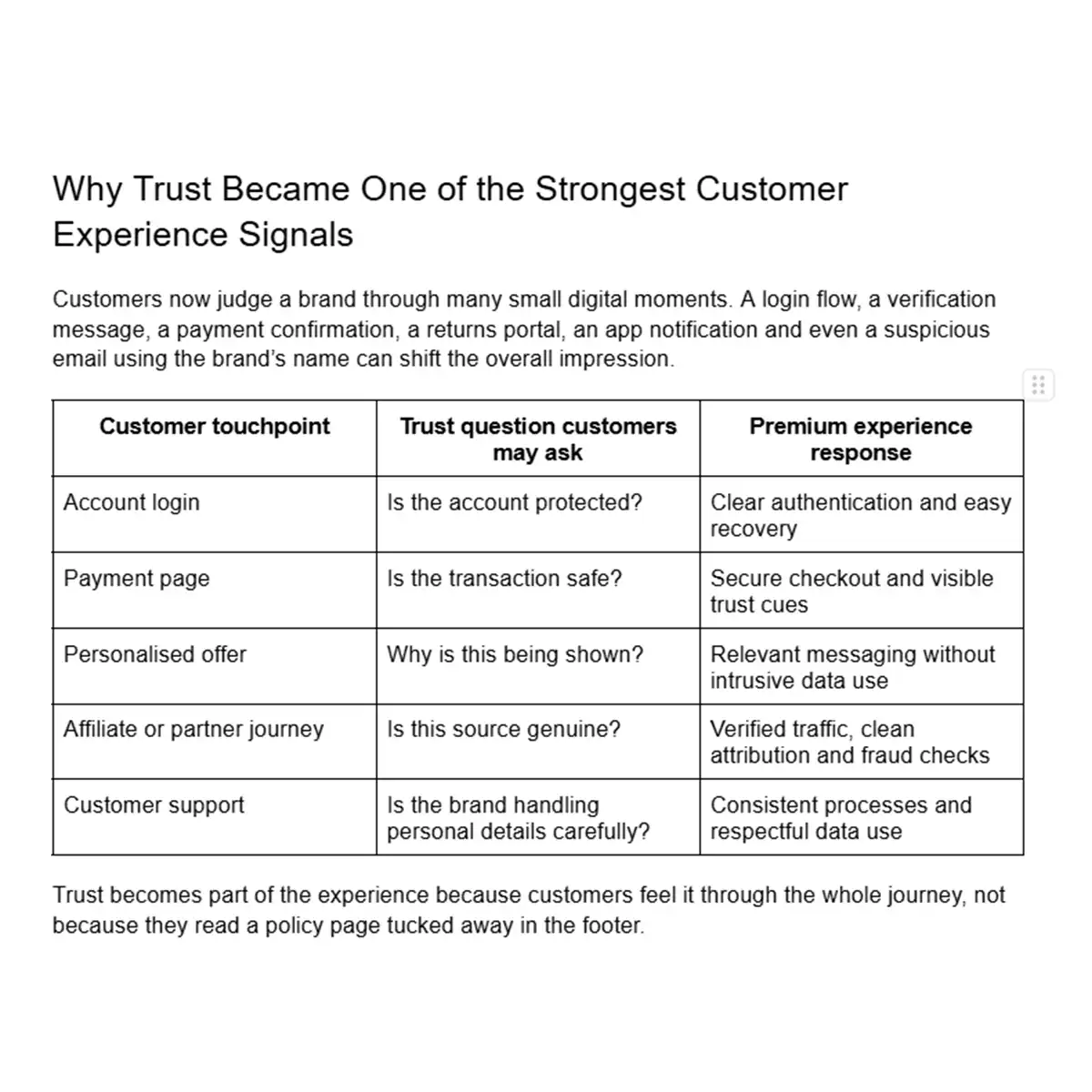
The Premium Customer Is More Digitally Aware
Premium audiences often expect speed and personalisation, but they also notice poor execution quickly. A generic fraud warning, a broken verification step or a misleading partner landing page can quietly damage the feeling of exclusivity.
At a glance, digital trust can seem like a technical matter. In practice, it becomes a brand issue. If a customer encounters suspicious redirects, fake promotions or inconsistent messaging, the problem is not only operational. It affects brand perception too.
The 2025 Edelman Trust Barometer Special Report on Brand Trust found that people rely strongly on the brands they use and that brand trust is becoming more connected to personal relevance and day-to-day experience. It is an important reminder: customers do not separate trust from experience as neatly as companies sometimes assume.
Where Digital Trust Can Break
Premium brands often invest heavily in polished customer journeys, but weak points can appear outside the main website. Partner traffic, affiliate promotions, loyalty referrals, influencer references and third-party landing pages can all shape how someone feels. Common weak points include:
Unclear tracking and attribution
Fake or low-quality partner traffic
Misleading promotional pages
Poorly protected account areas
Messages that feel too customised and intrusive
Slow action when suspicious activity appears
Inconsistent brand presentation across digital channels.
The lesson is clear: trust has to be managed across the whole customer path, not only on the brand’s official homepage.
Why Fraud Prevention Fits Experience Design
Fraud prevention is too often treated as a back-office topic. For premium brands, that perspective is too narrow. Fraud appears in the customer journey when it touches checkout, loyalty points, account security, partner deals or campaign attribution.
This matters even more in performance marketing. If a brand relies on partners to bring in higher-value customers, it has to confirm whether the traffic is real. When quality is poor, reports can become noisy, budgets may be spent in the wrong places and customers can be led into low-trust journeys. In that setting, affiliate fraud detection is not only a marketing safeguard. It becomes part of a broader trust approach.
A more disciplined acquisition ecosystem helps everyone. The business gets cleaner data, and customers encounter fewer suspicious or misleading touchpoints.
Balancing Personalisation and Privacy
Premium customers often appreciate relevant service. They may expect a hotel brand to remember preferences, a fashion retailer to suggest suitable items or a financial service to make the dashboard feel personal. But there is a line.
When personalisation feels useful, it can improve the experience. When it feels excessive, trust weakens quickly. Brands can reduce that risk by making data use clearer, limiting non-essential collection and giving customers more control.
How Premium Brands Can Build Digital Trust
Digital trust needs steady operational habits. It is not created by a single security badge. This approach may involve:
Clear privacy and consent language
Secure account and payment flows
Fast detection of suspicious activity
Careful monitoring of affiliate and partner traffic
Consistent brand presentation across landing pages
Transparent customer communication when something goes wrong
Regular review of data, fraud and campaign quality.
One more important point: these steps should not make everything feel heavy. Premium customers still expect speed and elegance. The goal is not to add friction everywhere. The goal is to make protection feel natural, not forced.
Digital Trust as a Premium Differentiator
Premium brands compete on more than price and product quality. They also compete on how customers feel before, during and after the purchase. If the digital path feels secure, coherent and respectful, trust becomes part of the brand’s value.
That may sound simple. It is not. It takes marketing, product, compliance, security and customer experience teams aligning around the same understanding of the customer journey, even when their daily tasks feel separate.
Continue Reading
The Marylebone Gazette
Delivered weekly to your inbox
Join 12,000+ Marylebone insiders