Marylebone hides world-class art behind quiet Georgian doors. A few minutes from the crowds of Oxford Street, one of the finest small museums in Europe sits in a townhouse on Manchester Square, a brutalist contemporary gallery occupies two buildings near the Marylebone flyover, and a single room on Chiltern Street shows art made by people the mainstream never recorded. The art galleries worth your time in Marylebone are not the obvious ones, and that is precisely their appeal. This is a neighbourhood where culture is dense but undersold, the opposite of a tourist trail.
This guide is for the curious visitor deciding where to spend an afternoon among them. It explains what each gallery actually holds, why it occupies the position it does in the London art world, and what is worth seeing in 2026, from a national collection that charges nothing to a commercial gallery showing some of the biggest names in contemporary art. The aim is to send you to the rooms that reward the detour, in roughly the order a thoughtful visitor would take them, rather than to list every space with a sign in the window.
Why These Galleries Reward the Curious Visitor
Marylebone rewards the curious because its art galleries span four centuries and almost no crowds. The Wallace Collection offers Old Masters and French 18th-century art for free, Lisson Gallery shows leading contemporary artists in raw industrial spaces, and the Gallery of Everything champions self-taught art, all within a short walk of one another.
The range is the point. Few neighbourhoods let you move from Fragonard to Ai Weiwei to an untrained French engraver in a single afternoon, and fewer still do it without queues or admission fees at most stops. Marylebone's quiet streets, never built for mass tourism, mean these spaces stay calm even when London's bigger museums are heaving, which changes how you experience the art.
What follows is a route rather than a directory, ordered so the historic anchor comes first and the contemporary and the unconventional follow. Treat a gallery afternoon here as one part of a fuller day in the neighbourhood, since the streets between the stops are half the pleasure.
how to spend a perfect luxury day in Marylebone
The Wallace Collection, Marylebone's Crown Jewel
The Wallace Collection is Marylebone's crown jewel and the place to begin. Housed in Hertford House on Manchester Square and free to enter, it holds the art assembled by the Marquesses of Hertford and Sir Richard Wallace, bequeathed to the nation by Lady Wallace in 1897 and kept largely as a private collection rather than a conventional museum.
The holdings are extraordinary for their size. The Wallace owns one of the finest collections of 18th-century French painting, furniture and porcelain anywhere, alongside Old Masters and one of the best armouries in Britain. Its most famous paintings, Fragonard's The Swing and Frans Hals's The Laughing Cavalier, are the kind of works most cities would build a museum around, and here they hang in domestic rooms rather than vast galleries.
The family story behind it is as compelling as the art. Sir Richard Wallace, who completed the collection, was the likely illegitimate son of the 4th Marquess of Hertford, and inherited the unentailed art rather than the title. That accident of inheritance, and his widow's later decision to give everything to the nation, is why a private aristocratic collection of this scale survived intact and open to the public.
The setting is half the experience. Seeing these paintings in a Marylebone townhouse, surrounded by the furniture and objects of the same period, tells you more about how such art was lived with than any white-walled gallery could. In 2026 the museum pairs its permanent collection with a programme that has included Winston Churchill: The Painter and a series of Pride gallery talks, alongside Friday Lates and regular concerts.
Practically, entry to the permanent collection is free, the museum opens daily, and a glazed courtyard restaurant makes it easy to linger. Arrive in the morning to have the great rooms to yourself before the afternoon visitors, and check the website, since individual galleries occasionally close for a day at short notice.
Fun fact: For more than a century the terms of Lady Wallace's bequest meant the collection could never lend its works, so every piece had to be seen in Hertford House itself.
Lisson Gallery and Marylebone's Contemporary Edge
Lisson Gallery is Marylebone's contemporary heavyweight and free to visit. Opened on Bell Street in 1967, it grew into one of the most influential commercial galleries in the world, and it still occupies raw, almost brutalist spaces near the Marylebone flyover, split across buildings on Bell Street and Lisson Street.
The roster explains its reputation. Lisson has represented or launched artists including Anish Kapoor, Ai Weiwei, Marina Abramovic, Tony Cragg, Richard Long and Julian Opie, and a free walk through its spaces routinely puts you in front of work by names the national museums queue to show. The architecture, all concrete and volume, is designed to let large contemporary works breathe in a way a grand period building cannot.
The 2026 programme is reason enough to visit. Shows scheduled across the Bell Street and Lisson Street spaces include Rodney Graham, Sean Scully and Leiko Ikemura in the spring, Ken Price in early summer, and a Lubaina Himid and Magda Stawarska presentation from June, with exhibitions changing every few weeks. Because it is a commercial gallery, admission is free and the rooms are quiet on weekday afternoons.
The gallery's reach is genuinely global. From its Marylebone beginnings it now runs spaces in New York, Los Angeles and Shanghai, and has given solo shows to more than 150 artists across nearly six decades. Few commercial galleries anywhere have shaped contemporary art as consistently, which makes free access to its London rooms all the more striking.
For a visitor used only to ticketed museums, this is the revelation of Marylebone's art scene. Walking into a free gallery and finding a major Anish Kapoor or an Ai Weiwei installation, with no crowd and no barrier, is an experience the big institutions rarely offer.
The Gallery of Everything for Outsider Art
The Gallery of Everything, at 4 Chiltern Street, is Marylebone's most unusual space and dedicated entirely to outsider and self-taught art. It shows work by makers who sit outside the art-historical mainstream, often created beyond the gallery system altogether, and it is unlike anything else in the neighbourhood.
The current exhibition shows the appeal. Currency Exchange examines imagined money and medals through artists working outside the establishment, including Emile Josome Hodinos, a 19th-century French engraver who, while interned in a psychiatric hospital, drew an entire lifetime's series of fictional coins and currencies onto scraps of found paper. The work is strange, obsessive and quietly moving in a way polished contemporary art rarely is.
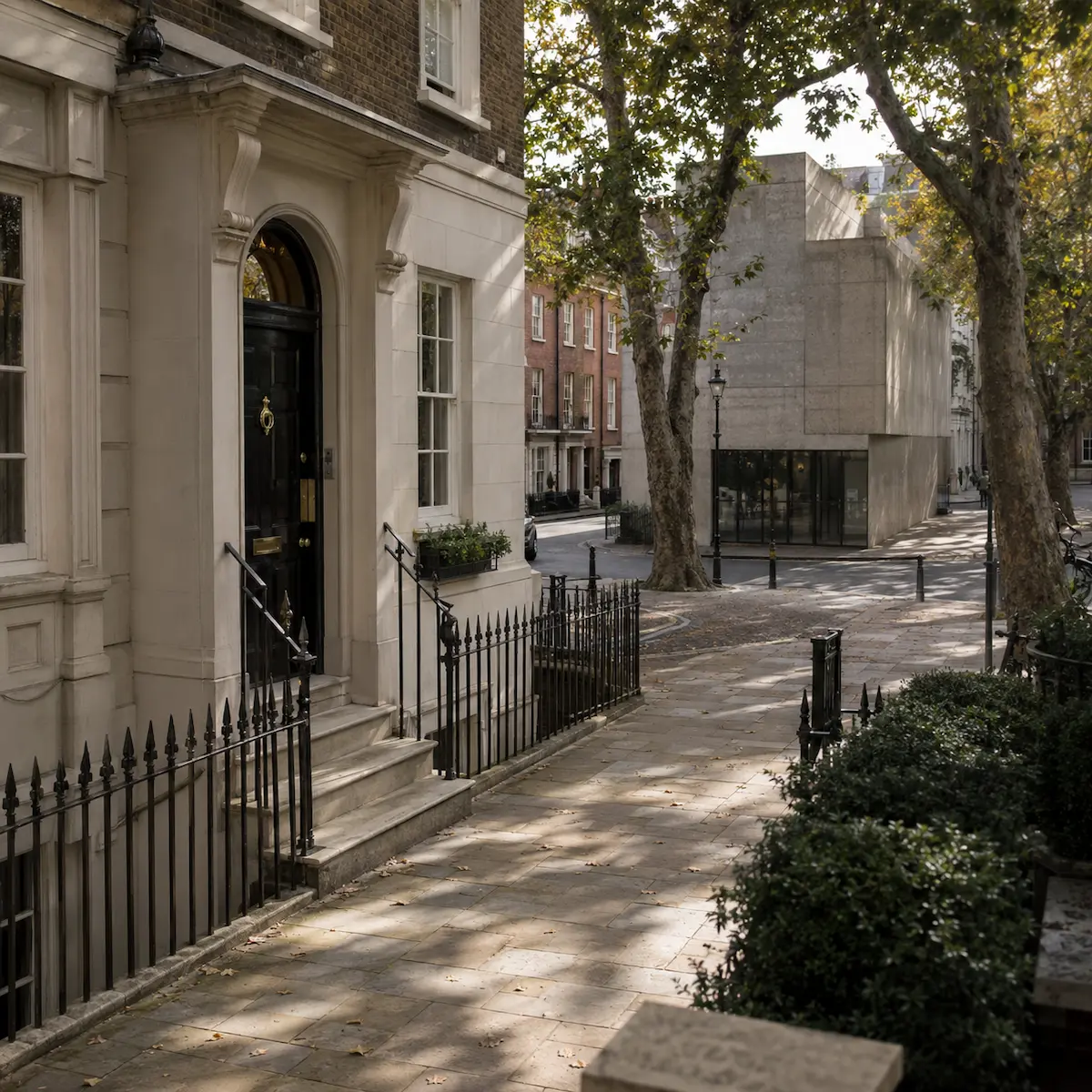
Chiltern Street suits it perfectly. The short Victorian red-brick run, already home to independent boutiques and the Chiltern Firehouse, has the character to carry a gallery this idiosyncratic, and the space rewards the visitor willing to spend time with work that asks for patience rather than recognition. It is the antidote to the blue-chip names a few streets away.
Beyond the Galleries, Marylebone's Cultural Layer
Marylebone's culture extends well beyond its galleries. The Royal Academy of Music Museum on Marylebone Road, free and open to the public on Fridays, displays historic instruments inside one of the world's leading conservatoires, founded in 1822, while Wigmore Hall offers some of London's finest chamber concerts a short walk away.
The neighbourhood also sits on the edge of the auction world. The major houses cluster just south around Bond Street in Mayfair, close enough to fold a viewing into a Marylebone day, and their pre-sale exhibitions are free and open to anyone curious enough to walk in. Even Daunt Books on Marylebone High Street, with its Edwardian oak galleries, functions as a cultural set-piece as much as a shop.
Together these layers give the neighbourhood a depth that a single gallery visit misses. A morning at the Wallace Collection, a concert at Wigmore Hall and an hour among the boutiques and bookshops add up to a cultural day that few central London districts can match in such a compact area.
the best designer boutiques on Marylebone High Street
How to See Marylebone's Art Galleries in an Afternoon
To see Marylebone's galleries well in an afternoon, start at the Wallace Collection in the morning, walk to Lisson Gallery for contemporary work, and finish at the Gallery of Everything on Chiltern Street. The route runs roughly east to west and covers four centuries of art in under two miles of walking.
Timing matters more than most visitors realise. Reach the Wallace Collection soon after opening to see its rooms before the groups arrive, save the Royal Academy of Music Museum for a Friday when it opens to the public, and check Lisson's exhibition dates, since its shows change every few weeks and the spaces close briefly between them. October, during Frieze, is when the whole London art scene is at its most active.
The reward for planning is a quiet, unhurried day with world-class art and no queues. For the lesser-known turnings and the parts of the neighbourhood most visitors miss between the galleries, it is worth straying off the obvious route.
Marylebone beyond the high street for repeat visitors
Start with the Wallace Collection, because a free national museum of this quality, set in a Marylebone townhouse, is the clearest argument for the neighbourhood as a cultural destination. From there, let curiosity lead, to Lisson Gallery for the contemporary heavyweights, to the Gallery of Everything for the work no one else shows, and to Wigmore Hall or the Royal Academy of Music if the timing suits. Check opening days and exhibition dates before you set out, since most of these spaces are free but not all are open every day. The art galleries worth your time in Marylebone reward the visitor who treats the neighbourhood as a slow afternoon rather than a checklist, which is exactly how its quiet streets prefer to be read, one unhurried room at a time.
Continue Reading
The Marylebone Gazette
Delivered weekly to your inbox
Subscribe for the latest from Marylebone.