There is a particular moment in the working day at 9 Hatton Garden when the showroom goes quiet, the consultation desks are occupied, and three different couples are looking at three completely different rings being made for three completely different lives. None of those rings exist yet. All three will exist in eight to ten weeks, each one specific to the people sitting at the desk. This is what Smith and Green Jewellers does for a living, and it is the thing the website cannot quite explain. Bespoke fine jewellery, made in Hatton Garden, by a specialist house that has been doing this work at this address for over a decade. If you are reading this because you came across our name and wanted to understand what we actually offer, this article is the considered answer.
A specialist house with a working bench
Smith and Green operates a single showroom at 9 Hatton Garden in the EC1N postcode, a five-minute walk from Chancery Lane station and Farringdon Elizabeth line. The business is registered at Companies House under number 07786083 and has been trading continuously at this address for over a decade. We are not a chain. We are not a franchise. The decisions about which stones to hold, which designs to produce, and which clients to take on are made by the people whose names are on the door.
Our focus is engagement rings, wedding bands, bespoke fine jewellery, and certified diamond and coloured-stone pieces. The work is built around a dedicated Italian workshop that produces our rings to specification, and a curated stone inventory sourced directly from the EC1N trade network on Greville Street, Leather Lane, and the surrounding addresses. This combination — Hatton Garden trade access, in-house design, controlled workshop production — is what allows us to offer bespoke commissions across a wide price spectrum without compromising on the quality of the stones or the finish of the metal.
What bespoke actually means at Smith and Green
Bespoke is a word the jewellery trade overuses. At Smith and Green it has a specific meaning. A bespoke commission is a ring designed for one client, around one stone, in one specification, to fit one finger. There is no catalogue from which the design is picked. There is no template that gets adjusted. The process begins with a conversation and ends with a hallmarked ring that did not exist anywhere before that conversation.
The conversation matters because the design follows it. We ask about the wearer. How they live, what they wear on their hands during a normal week, whether they value visible sparkle or quiet presence, whether they have inherited a stone they want incorporated, whether there is a proposal date driving the timeline. The answers shape the design before any sketch is drawn. For a closer look at how the timing of a bespoke commission actually works, [INTERNAL LINK: bespoke timelines for a custom setting | Article 5 — bespoke timeline].
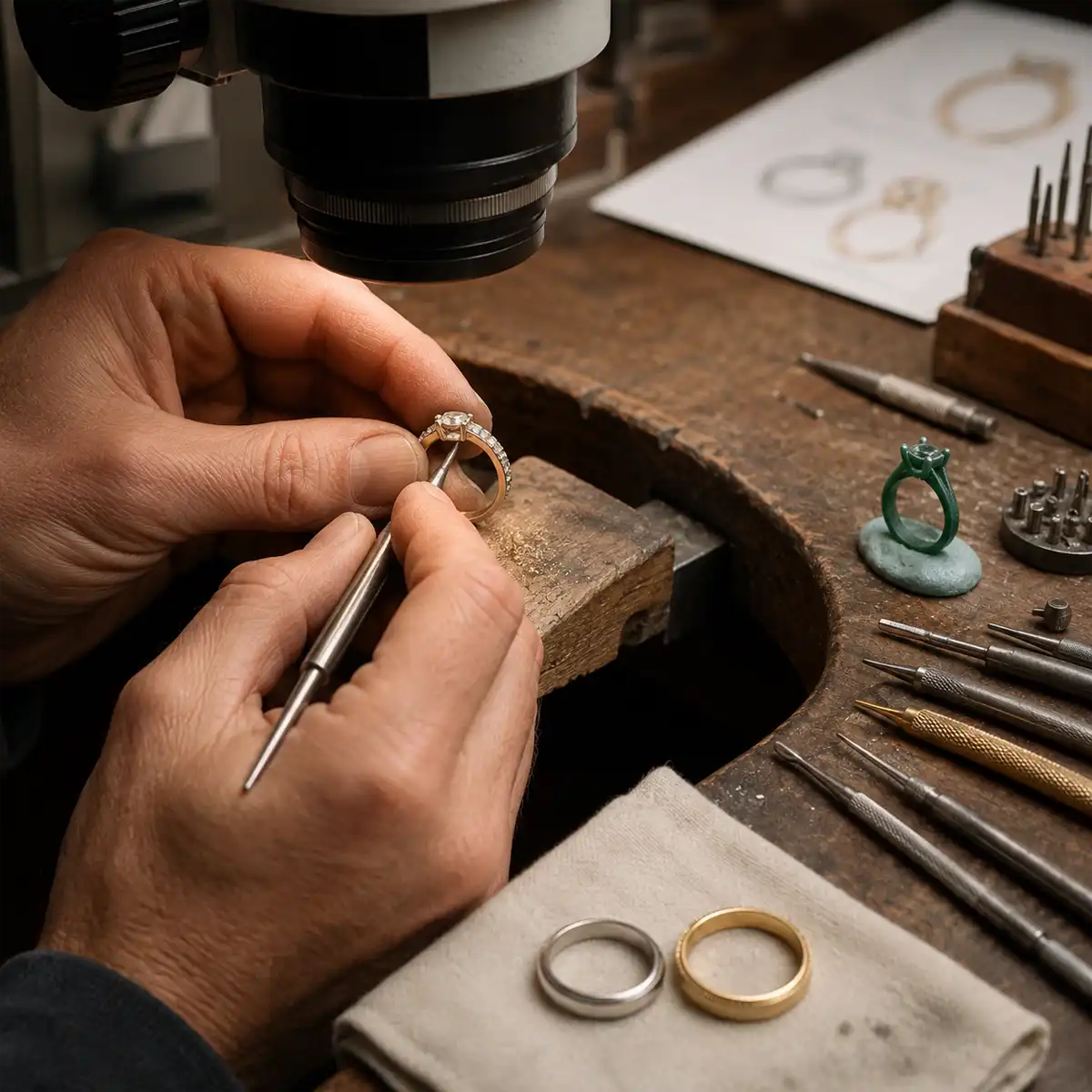
From the conversation comes a CAD render, accurate to the tenth of a millimetre, which you review on screen before any metal is cut. Revisions are expected. Most rings move through one to three rounds of revision before the design is locked. Only then does production begin, and only then is the centre stone formally committed. This sequence matters because it means no client commits to a stone before the ring it will sit in has been fully visualised.
The stones we hold and how we choose them
Our diamond inventory is curated stone by stone rather than purchased in parcels. Every diamond above 0.30 carats in our showroom carries an independent grading report from GIA, IGI, or HRD, and the certificate sits with the stone in the inventory file. The buyer above 0.30 carats sees the paperwork before they see the stone. This is not standard across the trade and it is not negotiable at Smith and Green.
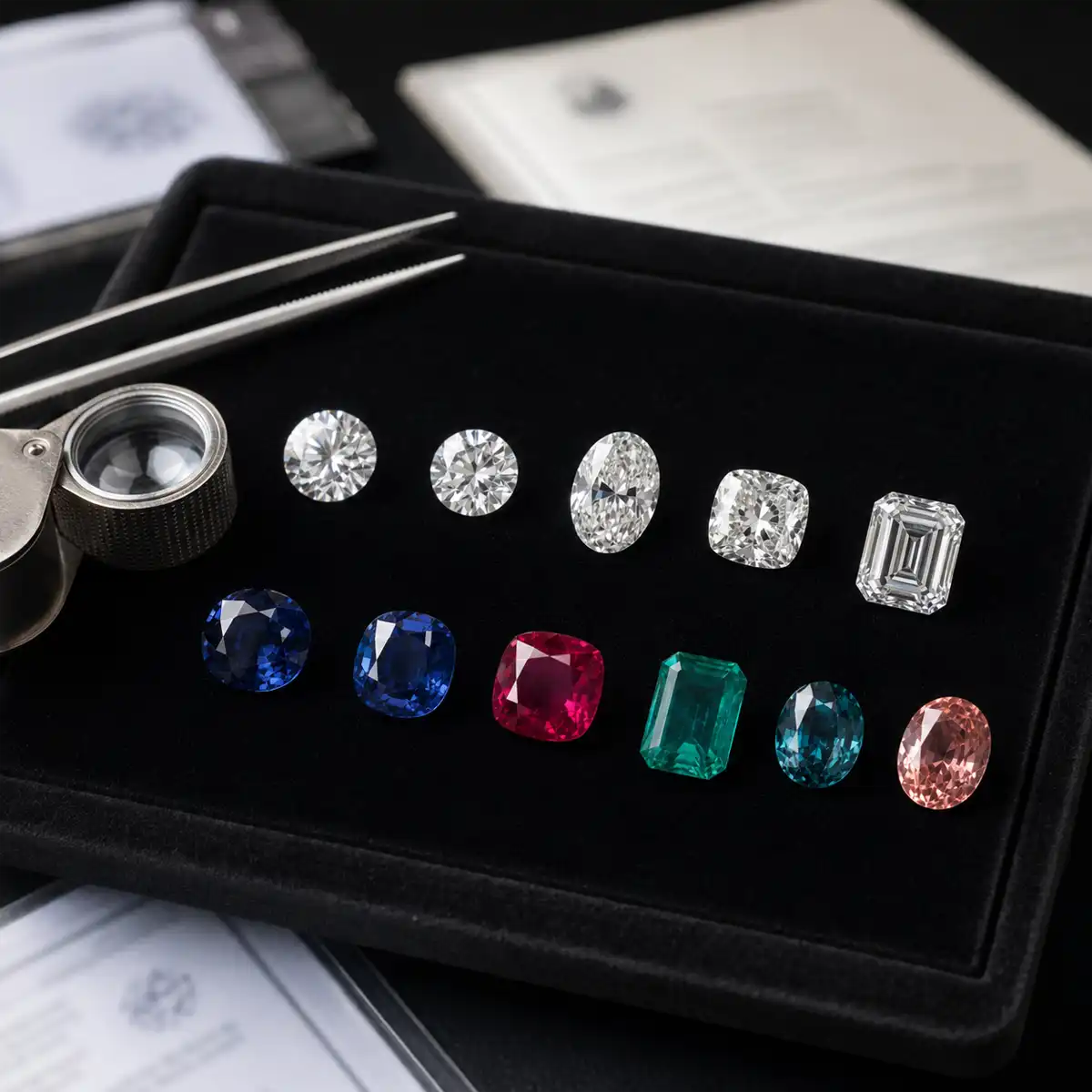
We hold both natural and lab grown diamonds across the major shape and quality range, with a particular depth in round brilliant, oval, cushion, and emerald cuts where buyer demand is strongest. Coloured stones are held in sapphire, ruby, emerald, and increasingly in padparadscha and teal sapphire as buyer preference has shifted toward coloured centre stones. Every coloured stone above 0.50 carats carries an independent laboratory report stating origin where determinable and treatment in full.
What this depth allows is a specific kind of consultation moment. When you specify a 1 carat G VS1 excellent cut round brilliant, we can put 10 to 15 stones in that exact specification on a black tray under daylight-balanced lighting on the same afternoon. You will see, in front of you, that two stones at the same nominal grade can perform visibly differently in light. The one you choose is the one you choose because it is yours, not because it was the only one in the cabinet. For the broader picture of how lab grown and natural compare under this kind of side-by-side viewing, [INTERNAL LINK: comparing lab and natural at a specialist | Article 1 — lab grown vs natural].
The workshop that makes the work
A ring is only as good as the bench that builds it. The Smith and Green workshop is a long-standing relationship with an Italian production facility that works to our specifications and our scheduling. The goldsmiths, setters, and polishers who make our rings are named individuals whose work we know by sight. We can identify which setter set a particular pavé band from across a room.
This relationship produces a consistency that subcontracted production cannot. Every Smith and Green ring is made to the same metal specifications. Our 18ct yellow gold is the same alloy in 2026 as it was in 2020, and a wedding band commissioned now to pair with a Smith and Green engagement ring from five years ago will match at the metal level. Our 950 platinum is the same composition across commissions, which means the colour, the density, and the wear characteristics are predictable.
Every ring is hallmarked at the London Assay Office, a short walk from the showroom near Greville Street. The hallmark is the legal record of the metal purity, the year of assay, and the maker's mark, stamped into the inside of the band. It is the chain-of-custody document that travels with the ring for the rest of its life. We do not skip it, abbreviate it, or substitute it with foreign hallmarks. UK rings made in our workshop receive UK hallmarks, full stop.
How materials and finishes are chosen
The metal you choose shapes the ring more than most buyers expect, and the choice happens early in the consultation.
Platinum is our most-specified metal for engagement rings and is the recommendation for buyers prioritising durability, weight, and a stable white colour that does not require periodic surface treatment. Our platinum is 950 specification, which is the dense, hard alloy traditionally used for fine jewellery.
18ct yellow gold remains the second most-specified metal for engagement rings and carries the warm classic character that suits both vintage and modern designs. Our yellow gold is alloyed for hardness and colour consistency, and we hold matching stock for wedding band pairings.
18ct white gold suits buyers who prefer a white-toned ring at a lower price point than platinum. We are transparent about the rhodium replating cycle that white gold requires, and we include the first replating in the lifetime aftercare proposition.
18ct rose gold has gained substantial ground in the past five years and suits buyers looking for warmth without the strong yellow tone. The alloy is gold plus copper, and the colour is consistent across our stock to allow for matched-set wedding band pairings.
950 palladium is held for clients who specifically request it. It is rarer in the current UK market but remains a legitimate fine-jewellery metal with its own character.
The consultation and what to expect
A Smith and Green consultation lasts 60 to 90 minutes. The desk is set back from the showroom window, the lighting is daylight-balanced, and tea or coffee is offered. The consultant is briefed to listen before they show anything. The first ten minutes are about you, the next 20 to 30 about education calibrated to what you already know, the middle 30 to 40 about practical viewing of stones, sample rings, and CAD renders, and the final ten about next steps.
You are not asked to commit on the same day. You are encouraged to take written quotes home, to compare, to think, and to come back when you are ready. Most of our clients make two or more visits before committing. None of them are pressured. For first-time visitors who want to understand the broader context of what a Hatton Garden visit involves.
Fun fact: The 9 Hatton Garden address itself sits within a row of buildings whose ground floors have housed jewellery trade businesses continuously since the late 19th century, making the street one of the longest continuously traded fine-jewellery sites in the United Kingdom.
What happens after you collect the ring
A ring is not a transaction. It is a 40-year relationship with the maker, and our aftercare proposition reflects that.
Complimentary cleaning and inspection at the showroom continues for the lifetime of the piece. You walk in, hand the ring to a consultant, and have it cleaned and prong-checked while you wait. No charge. No appointment required. No minimum spend.
Resizing within the first year is included in the purchase price. After the first year, resizing is offered at workshop cost. For 18ct white gold rings, rhodium replating is offered every 18 to 36 months at workshop cost. Wear-related repairs to claws, settings, or bands are carried out in-house by goldsmiths familiar with the original build.
Trade-in credit is offered against future purchases on every stone we have sold. This matters for clients who want to upgrade for an anniversary or who eventually want to remodel an inherited piece. For the post-purchase administrative work that protects the ring properly.
The people behind the rings
Smith and Green is not a faceless brand. The consultants you meet at the desk have backgrounds in gemmology, fine jewellery retail, and bespoke design, and they are the same consultants you will see on return visits, on aftercare appointments, and on any future commission. Continuity matters at this kind of purchase. The person who knows your engagement ring is the person you want to see when you commission your wedding bands, and again when you upgrade for a tenth anniversary.
The design team works directly with the workshop, and the workshop works directly with the design team. Decisions are made in conversation rather than across departmental silos. When a CAD revision is requested at the consultation desk, it is back in render form often the same day. When a workshop query arises during production, it is answered by the designer who specified the piece, not by a customer service intermediary.
Conclusion
Smith and Green Jewellers offers bespoke fine jewellery, certified engagement rings, wedding bands, and coloured-stone pieces from a single specialist showroom at 9 Hatton Garden in EC1N. The work is built on a curated stone inventory, a dedicated Italian workshop, in-house design, transparent pricing, and lifetime aftercare. The buyer who finds us at our most useful is the buyer who wants a ring designed for them rather than chosen from a catalogue, who values the depth of stone selection that direct Hatton Garden trade access provides, and who wants a long-term relationship with the people who made the piece. Book a consultation, allow 60 to 90 minutes, bring reference images and any sizing information you have, and arrive ready for a conversation. The ring you walk out with weeks later will be the one designed in that conversation, and that is what the Smith and Green approach to bespoke fine jewellery in Hatton Garden actually means.
Continue Reading
The Marylebone Gazette
Delivered weekly to your inbox
Join 12,000+ Marylebone insiders