Someone comes back to the showroom at 9 Hatton Garden holding a ring in a tissue, and they are apologising before they have sat down. They have not worn it for 3 weeks because a claw felt sharp against a jumper and they were frightened to look closer. They are certain they have ruined it.
They have not ruined it. They have caught it.
That is the whole point of engagement ring servicing, and it is why the version of this conversation that happens at 3 weeks is a 20-minute job, while the version that happens at 3 years is sometimes a rebuild. A ring worn every day is a small piece of engineering under constant low-level assault. Doors, handbags, gym equipment, washing up, coat pockets, car keys. None of it dramatic. All of it cumulative.
Nobody tells you this part when you buy. The conversation is about carat and cut and the moment on the bridge, and then the ring goes onto a hand and stays there for 40 years and the aftercare instructions are, at best, a line on a card. So here is what actually wears, how fast, and what to do about it. There is nothing frightening in any of it.
How often does an engagement ring need servicing?
An engagement ring worn daily should be professionally inspected once every 12 months. The check covers claw and setting security, stone tightness, and general wear. White gold typically needs re-rhodium plating every 1 to 3 years to restore its bright finish. Platinum needs re-polishing rather than re-plating, on no fixed schedule. Cleaning can be done as often as you like.
Smith & Green include yearly inspections, complimentary polishing and cleaning, and a full lifetime warranty with every piece. The workshop is on site, which is why an annual check at 9 Hatton Garden is a conversation rather than a dispatch note.
Once a year sounds like a lot until you consider that the alternative is finding out by touch, in a jumper, 3 weeks late.
What actually wears on a ring you never take off
Claws are the first thing to go, and they go slowly enough that you will not notice.
A claw setting holds the stone with 4 or 6 tips of metal bent over the girdle. Those tips are the highest points on the ring, which means they take every contact first. Over years they thin, and then they shorten, and eventually one lifts slightly away from the stone. The stone does not fall out at that moment. It gets microscopically loose, then rattles, then goes, and the gap between the first stage and the last can be months. An annual check catches it at stage 1, when a jeweller re-tips the claw in 30 minutes and the stone never moves.
Rhodium is the second. White gold is not naturally white. It is a yellow gold alloy plated with rhodium to give it that bright, cold finish, and the plating is microns thick. It wears. Skin acidity, hand washing, and how much you use your hands all change the rate, which is why 1 person needs re-plating at 12 months and another at 3 years. When white gold starts looking faintly warm or yellowish underneath, that is the plating thinning. It is not damage and it is not your fault.
Platinum behaves differently. When platinum scratches, the metal displaces rather than disappears, so a worn platinum ring develops a soft matte patina instead of losing material. Some people love it. Some want it polished back. Either is fine, and neither is urgent.
Pavé is the quiet one. Small stones held by tiny beads of metal, and any of them can work loose without you feeling a thing.
What happens when you bring a ring in
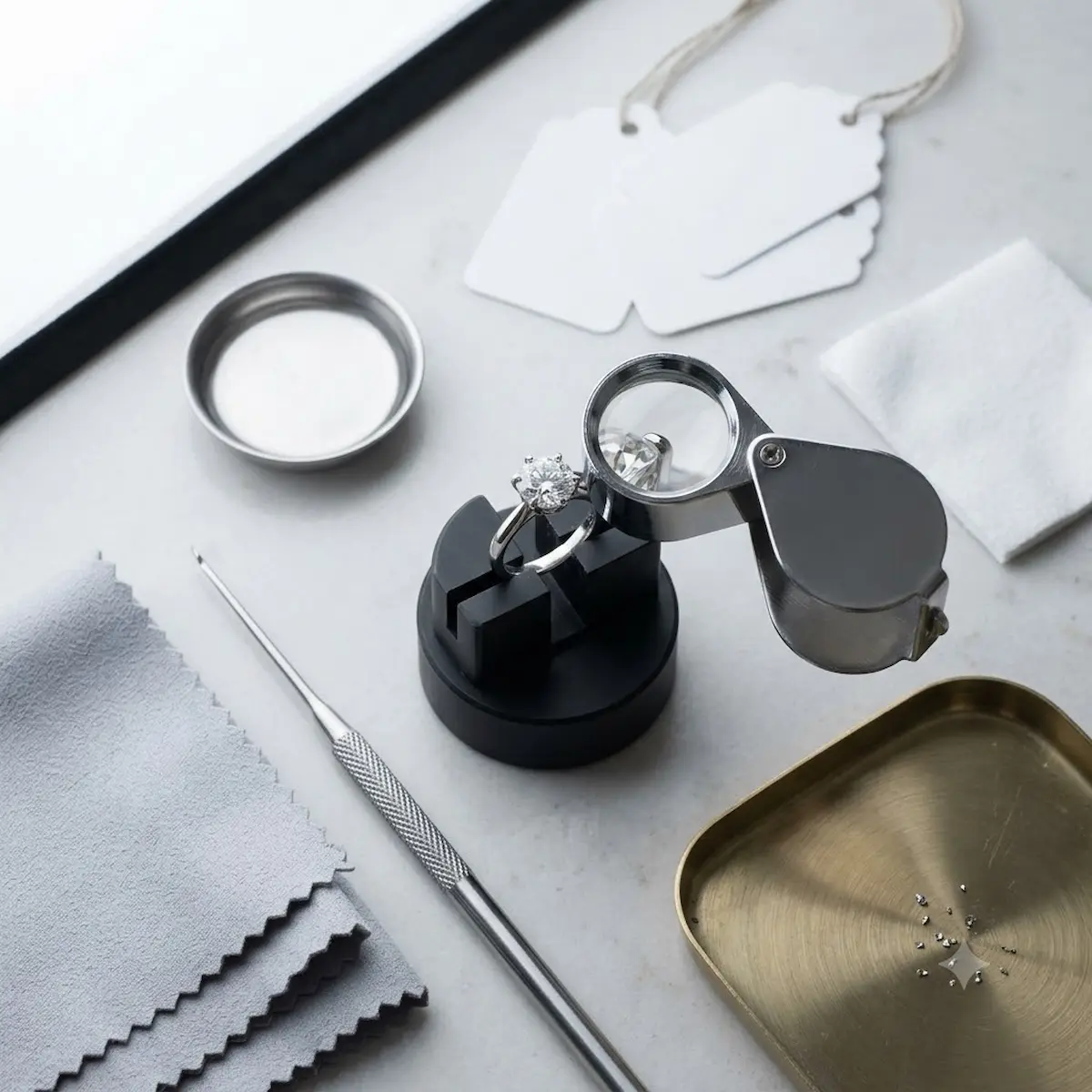
You hand it over and someone looks at it under magnification while you sit there. That is genuinely most of it.
The jeweller checks each claw with a fine probe, testing whether any tip has lifted. They check the stone for movement, which is done by touch and takes seconds. They look at the shank for thinning at the base, which happens on rings worn next to a wedding band because 2 rings rub against each other all day. They check pavé beads individually. If the finish has dulled, they say so and tell you what re-polishing or re-plating would involve.
Most annual checks end with the ring cleaned, polished, and handed straight back. Some end with a small job that takes a few days. Very occasionally somebody has left it long enough that a claw needs rebuilding rather than re-tipping, and even that is routine.
You will not be told off. Everyone at the bench has seen a ring worn for 15 years by someone who assumed it was indestructible, and the reaction is interest rather than judgement.
Can an engagement ring be resized and when it cannot?
Resizing is an alteration rather than servicing, and it has limits worth knowing before you need them.
A plain or lightly detailed band resizes easily, usually 1 to 2 sizes in either direction, by cutting the shank and adding or removing metal before re-soldering and re-finishing. Fingers change. Pregnancy, weather, weight, age, and medication all move ring size, and a ring that fits in July can be tight in January.
The limits are structural. A full eternity band set with stones all the way round cannot be resized conventionally, because there is no plain metal to cut. A ring with pavé running deep into the shoulders can only be adjusted at the base before the stone spacing distorts. Tension settings rely on the shank's spring to grip the stone, so altering the shank alters the grip. In those cases, the honest answer is sometimes that resizing is not sensible and sizing beads or a re-make are the better route.
Ask before you buy, not after. It is a 10 second question at the consultation desk and it changes which settings suit a person whose hands change.
Fun fact: Rhodium, the metal plated onto white gold rings to produce their bright white finish, is one of the rarest precious metals on earth, with annual global production measured in tens of tonnes against gold's thousands.
Why servicing and your insurance valuation are connected
An insurance valuation is not a one-off document. Its ages, and it ages against a moving market.
Most household policies covering a ring above a threshold value want a written valuation, and most want it refreshed periodically, commonly every 3 to 5 years. The reason is that replacement cost moves. Metal prices move. Stone prices move, and lab-grown diamonds have moved sharply enough in recent years that a valuation written in 2019 may describe a replacement cost that no longer resembles the current one in either direction.
The practical point is that an annual service is the natural moment to ask whether your valuation is current. The ring is already in front of someone qualified. If a claw has been rebuilt or a stone replaced, the paperwork should reflect the ring as it now is rather than as it was in the box.
Keep the laboratory report and the valuation together, and keep them somewhere that is not the ring box. A GIA or IGI report identifies your specific stone, and in a claim, it is the difference between describing a diamond and proving one.
Does a lab-grown diamond need different care?
No, and these catches people out.
A lab-grown diamond is chemically and physically the same material as a mined one. Same hardness, same structure, same behaviour in a setting. It scratches what a natural diamond scratches and it chips where a natural diamond chips. The servicing schedule is identical, the claws wear at the same rate, and the annual check is exactly as necessary.
What differs is the paperwork. Lab-grown stones carry grading reports stating laboratory origin, and that distinction matters for valuation rather than for care.
Conclusion
Book the first check at 12 months and then put it in the calendar annually, because the whole system depends on catching things at stage 1. Smith & Green take appointments Tuesday to Saturday, 09.30 to 18.00, at 9 Hatton Garden, EC1N, a 4-minute walk from Chancery Lane station or a short walk from the Farringdon Elizabeth line exit.
Ask 3 things when you are there. Ask whether any claw has thinned enough to need re-tipping this year or next. Ask whether the finish needs re-polishing or re-plating, and roughly when it will need it again. Ask whether your insurance valuation is still current, and get it updated if the ring has been altered.
If something feels sharp, catches on fabric, or rattles faintly when you shake it near your ear, do not wait for the annual slot. Engagement ring servicing is cheapest, quickest, and least frightening on the day you first notice.
Continue Reading
The Marylebone Gazette
Delivered weekly to your inbox
Subscribe for the latest from Marylebone.