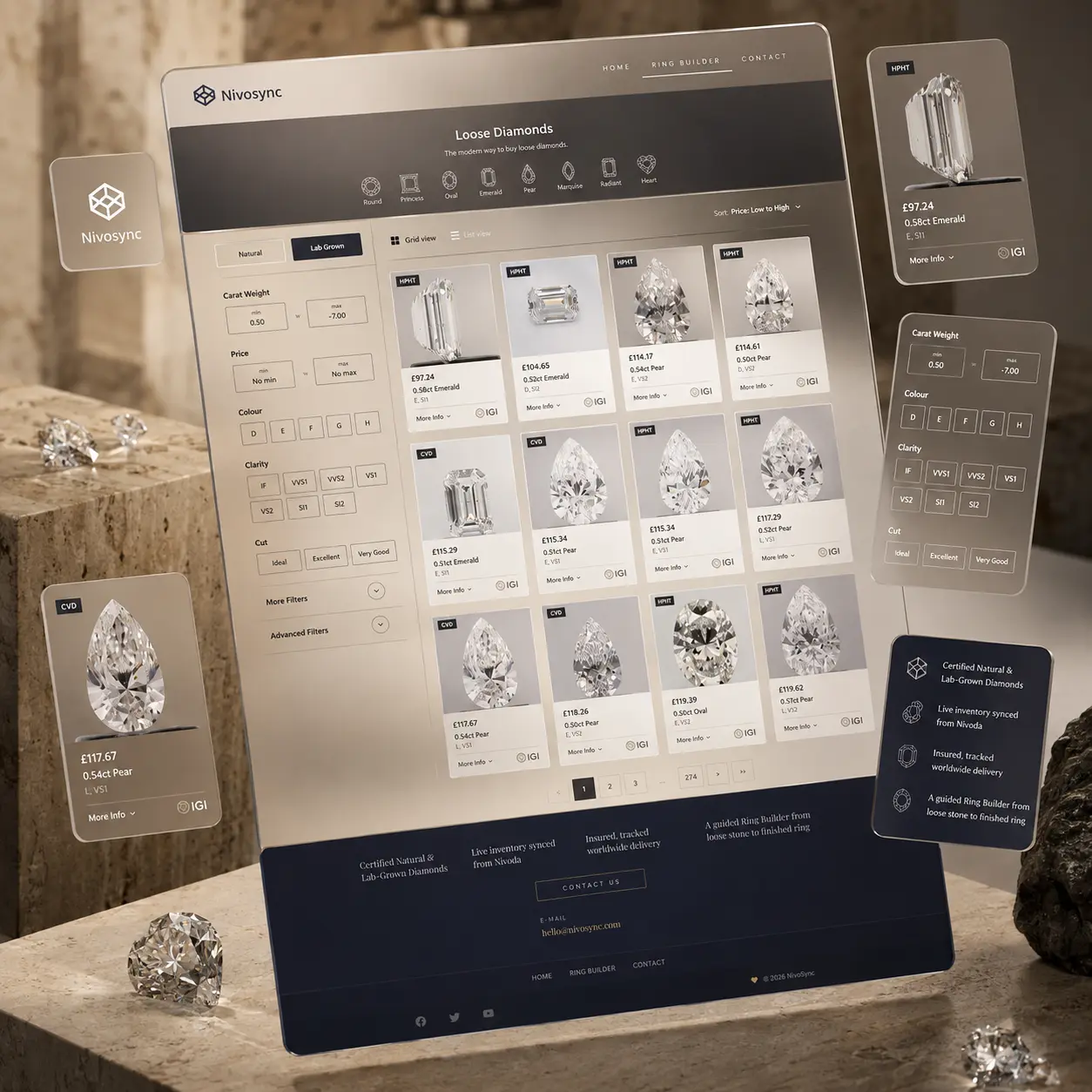
Marylebone has never traded on volume. The village between Marylebone High Street and Chiltern Street built its reputation on independents who know their stock personally, and its jewellers are no exception. Small workshops, considered windows, appointment books rather than footfall targets. Which makes what is happening to their websites quietly interesting. Over the past 2 years, independent jewellers across W1 have started publishing live, searchable diamond catalogue pages showing tens of thousands of certificated stones they do not physically hold.
It is the most significant change to how the district sells fine jewellery since card payments, and it has arrived without any of the fanfare that usually accompanies retail technology. No shop has rebranded around it and none of the windows look different. What has changed sits entirely on the website, and it has quietly removed the one competitive disadvantage that independent jewellers in this part of London could never engineer their way around.
Why a Marylebone Jeweller Would Publish Stock They Do Not Own
Independent jewellers publish sourced inventory because diamonds tie up capital that a small business cannot spare. A stone is a single object rather than a restockable line, so holding enough variety to satisfy a specific brief would require several million pounds sitting in a safe against uncertain demand.
Sourcing on demand inverts that. The jeweller lists inventory available through a wholesale marketplace, prices it with their own margin, and orders the individual stone once a customer has committed. Selection expands from a few hundred stones to several hundred thousand without a corresponding increase in risk.
For a district built on independents, this matters more than it would in a chain. A shop on Chiltern Street with 5 staff now competes on selection with national retailers while retaining the thing that brought customers to Marylebone in the first place, which is a person who will sit down and explain what they are looking at.
What Changed to Make This Affordable
The barrier was never the idea. It was the build cost. Connecting a wholesale diamond marketplace to a retail website is a software project, and agencies have routinely quoted somewhere between £15,000 and £40,000 for the integration work alone, before design and before the maintenance that follows.
At those figures independents simply opted out, which is why the first wave of online diamond selling in Britain belonged to funded national brands rather than to established local jewellers with better product knowledge. The economics excluded exactly the businesses best placed to advise customers.
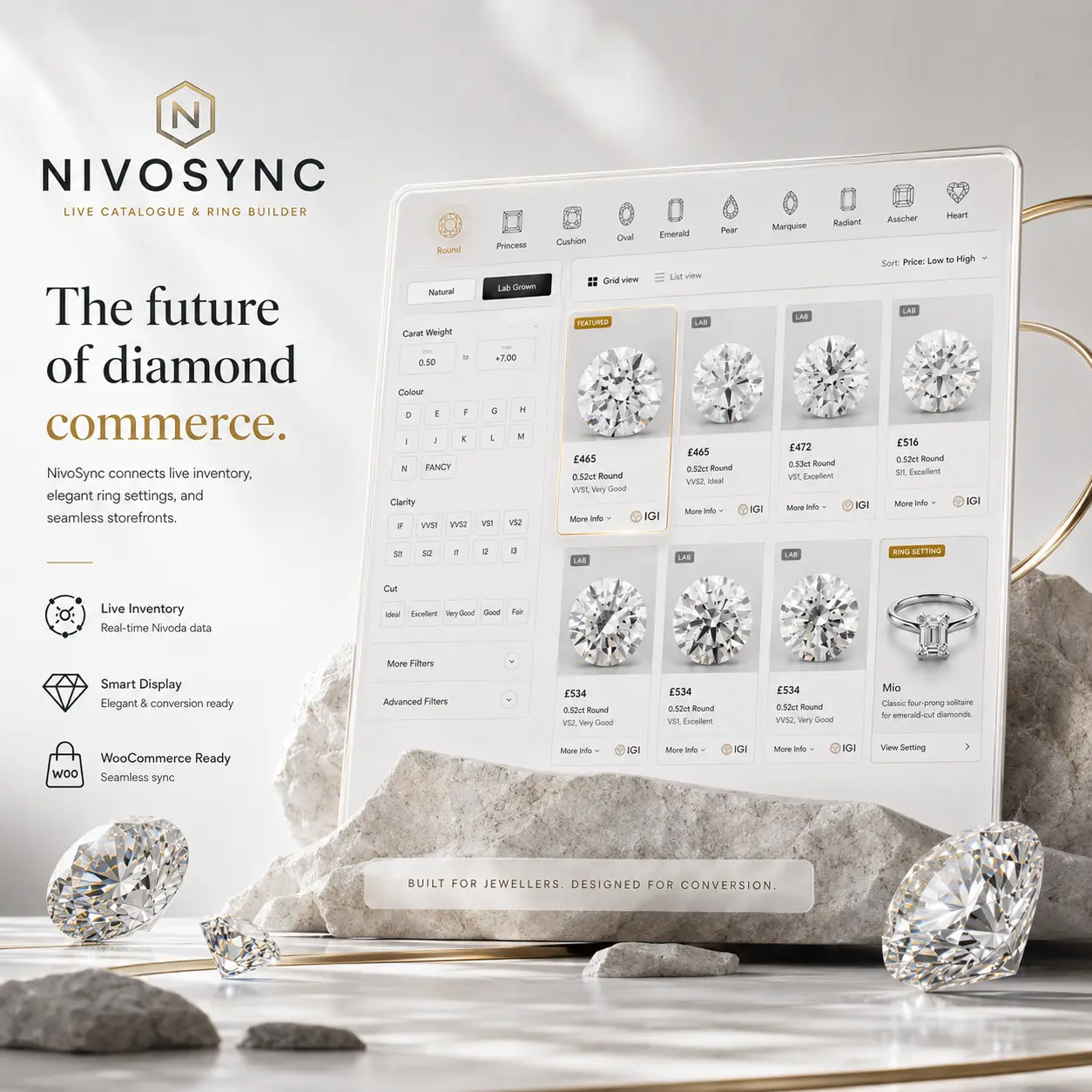
Packaged software has reversed that. NivoSync's diamond catalogue and comparable products deliver the marketplace sync, the local caching, the pricing rules and the checkout as a licensed plugin rather than a bespoke commission, which turns a capital project into an annual subscription. That single change is why the shops now going live are independents rather than groups.
How Fast a Diamond Catalogue Has to Be to Work
A diamond catalogue lives or dies on load speed, because a customer filtering 50,000 stones will abandon a page that takes 3 seconds to redraw. The technical answer is a hybrid approach that serves the page from a local copy of the data while checking the marketplace in the background.
The alternative designs both fail in ordinary use. Querying the marketplace live on every interaction is accurate and far too slow. Serving from a nightly import is instant and shows stones that sold this morning. Hybrid caching gives sub-second responses while a background process merges current pricing and removes stones that are gone, so the next visitor sees fresh data without ever waiting for it.
Benchmarks on current implementations report median page loads under 200 milliseconds on catalogues of 50,000 stones, with incremental updates completing in roughly 30 seconds. Those numbers are worth knowing as a customer, because a sluggish diamond page usually indicates a cheap integration rather than a busy server.
Fun fact: Marylebone takes its name from a church dedicated to St Mary that stood beside a stream called the Tyburn, giving St Mary at the Bourne, which contracted over centuries into the name used today.
What Marylebone Buyers Should Do Differently Now
Use the catalogue before the appointment, not instead of it. The sequence that works is to shortlist online, then book, then compare in person, and each stage does a job the other cannot.
Online research earns you comparison. Filter to your budget and shape, then look at what one grade in either direction actually costs. Colour and clarity move price steeply while often moving appearance very little, particularly once a stone is mounted. Note the certificate numbers of 4 or 5 candidates and verify them independently on the issuing laboratory's website, whether that is GIA, IGI, HRD or GCAL.
The appointment earns you judgement. Certificates describe stones but do not photograph them, and two diamonds graded identically can look meaningfully different depending on crown angle, pavilion depth and fluorescence. Ask to see your shortlist side by side under consistent lighting. Ask which the jeweller would choose and why. That answer is the reason to buy in Marylebone rather than from a website with a call centre. Our overview of where to buy fine jewellery in Marylebone covers which houses handle bespoke work in-house.
The Lab-Grown Question Every Catalogue Now Raises
Every current diamond catalogue carries a first-class toggle between natural and laboratory-grown stones, and seeing the two priced side by side is the fastest education a buyer will get on the subject.
Laboratory-grown diamonds are chemically and optically diamond, graded on the same 4Cs scale, and typically certificated by IGI rather than GIA, which has become the market convention. The price gap is substantial and has widened as production has scaled, which is precisely why the comparison is instructive rather than academic.
The considerations are resale and intent rather than quality. Laboratory-grown stones have depreciated significantly as supply increased, so they are best understood as jewellery rather than as a store of value, while natural stones of good grade have held their position more robustly. Neither is the correct answer universally. We set the trade-offs out fully in our piece on lab-grown diamond rings in the UK. What a catalogue does well is make the decision concrete, because seeing what the same budget buys in each category is more useful than any general argument.
Practical Checks Before You Commit
Ask what happens to your stone between payment and delivery. A properly integrated catalogue places an automatic hold on that exact diamond with the supplier at checkout and releases it if you cancel. Without that step, a genuinely unique stone can be sold twice, and the customer who loses gets a phone call rather than a ring.
Confirm the hallmark. UK law requires an Assay Office hallmark on precious metal articles above the statutory weight thresholds, and London is the office most West End work passes through. Confirm whether the quoted price includes VAT and the setting or covers the loose stone alone, since catalogues sometimes display the stone price in isolation.
Establish your return position in writing before paying a deposit. The Consumer Rights Act 2015 protects you against goods that are faulty or not as described in every case. The 14-day cooling-off period for distance purchases, however, generally does not extend to rings made to your specification, and a sourced stone set into a chosen mount will usually be treated as bespoke. Ask directly which category applies.
Ask about resizing policy and the interval at which the jeweller recommends having settings checked, because independents in this district typically offer aftercare that national retailers do not, and it is worth having on the invoice.
Why This Suits Marylebone Particularly Well
The district's jewellers were never going to win a price war and have never tried. What restricted them was reach, specifically that a customer researching at 11pm found nothing to look at and drifted towards a national brand by default.
A live diamond catalogue removes that single disadvantage while leaving everything else intact. The stones on the page are the same stones a competitor 3 miles away is showing. What differs is the setting design, the workshop, the person conducting the appointment and the aftercare, which is exactly the ground a Marylebone independent wants to compete on.
If you are buying, start online, shortlist properly, and then walk into the shop with certificate numbers in hand. You will get a better conversation, and the jeweller will get a customer who already knows what they want, which is a fair trade on both sides.
Do not treat the online price as the final word either. Independents in Marylebone frequently include services in a quoted figure that a national retailer charges separately, including sizing, an insurance valuation and a first setting check. Ask what is bundled before comparing totals, because the cheaper headline price is often the more expensive ring by the time it is on a finger. A diamond catalogue tells you what a stone costs. It does not tell you what the relationship is worth, and in this district that has always been the larger part of the value.
Continue Reading
The Marylebone Gazette
Delivered weekly to your inbox
Join 12,000+ Marylebone insiders