The stallholders behind Marylebone High Street will not sell you so much as an apple before 10am. Regulars note that Marylebone Farmers’ Market holds its opening time strictly, and the discipline sets the tone: this is a producers’ market with rules, not a food festival with bunting. Every Sunday, rain or shine, from 10am to 2pm, farmers, fishermen and bakers set up in the Cramer Street car park behind Waitrose, spilling along Aybrook Street, St Vincent Street and the top of Moxon Street, in W1U in the City of Westminster, at the quiet top of the West End. Established in 2003 and run by London Farmers’ Markets, the Sunday market is regularly described as the largest of the group’s twenty or so sites, and it has anchored the district’s weekend for more than two decades. What follows is how to shop it properly: the timings that matter, what early autumn puts on the tables, and how it fits against the food shops a street away.
When It Runs and Where Exactly
Marylebone Farmers’ Market runs every Sunday of the year from 10am to 2pm, whatever the weather, in and around the Cramer Street car park just off Marylebone High Street, directly behind the Waitrose supermarket. The nearest stations are Baker Street and Bond Street, each a walk of under ten minutes.
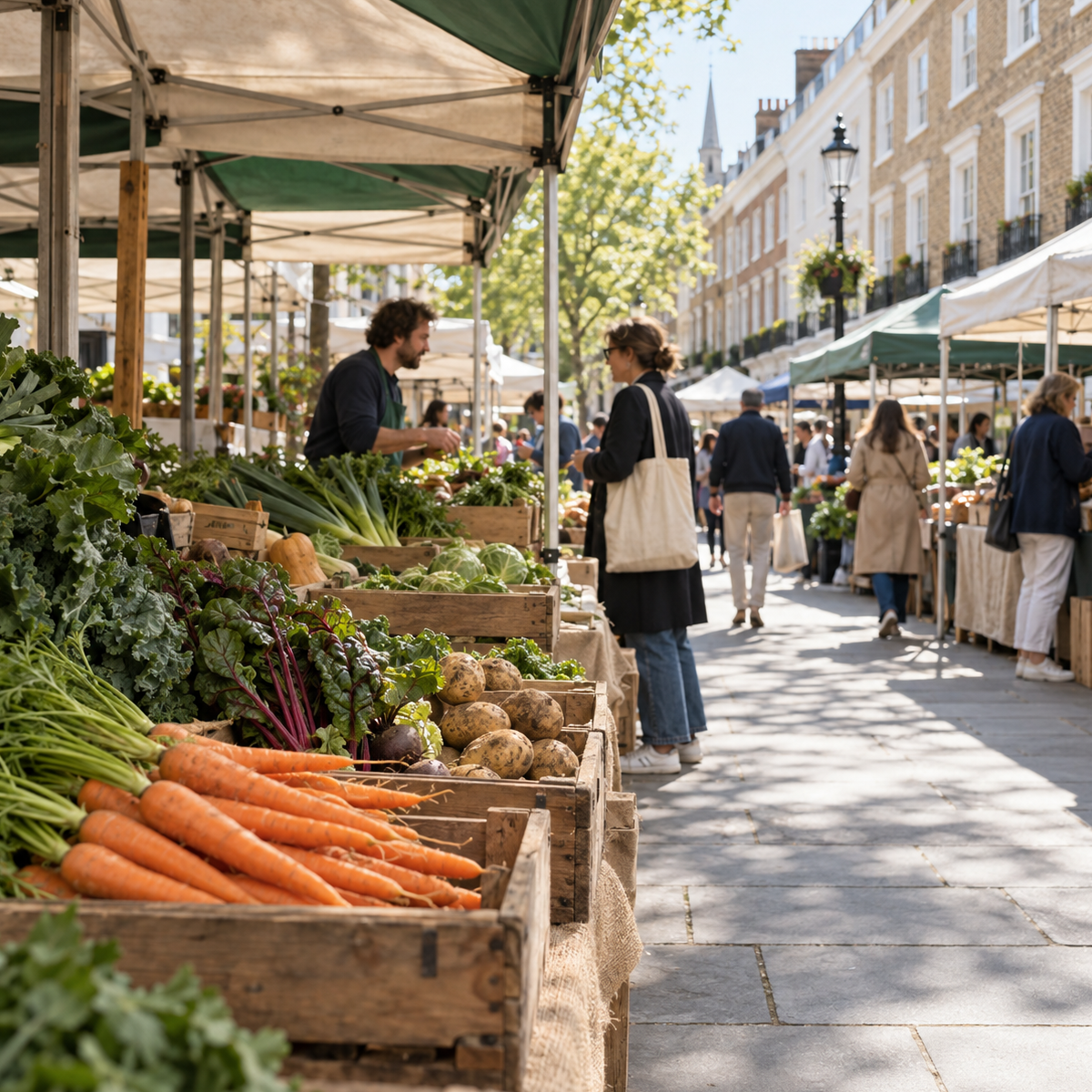
The geography is the first thing to get right, because Marylebone Farmers’ Market does not sit on the High Street itself and first-timers routinely walk past it. Cramer Street is a side turning towards the northern end of the High Street; the stalls fill the car park and the adjoining streets, with a couple of them closed to traffic for the morning. On a full Sunday the count runs to around 30 stalls by recent tallies, though the honest caveat belongs in the plan: not every producer attends every week, and some come only in their season, so the market you meet in September is genuinely not the one from March.
What Early Autumn Puts on the Tables
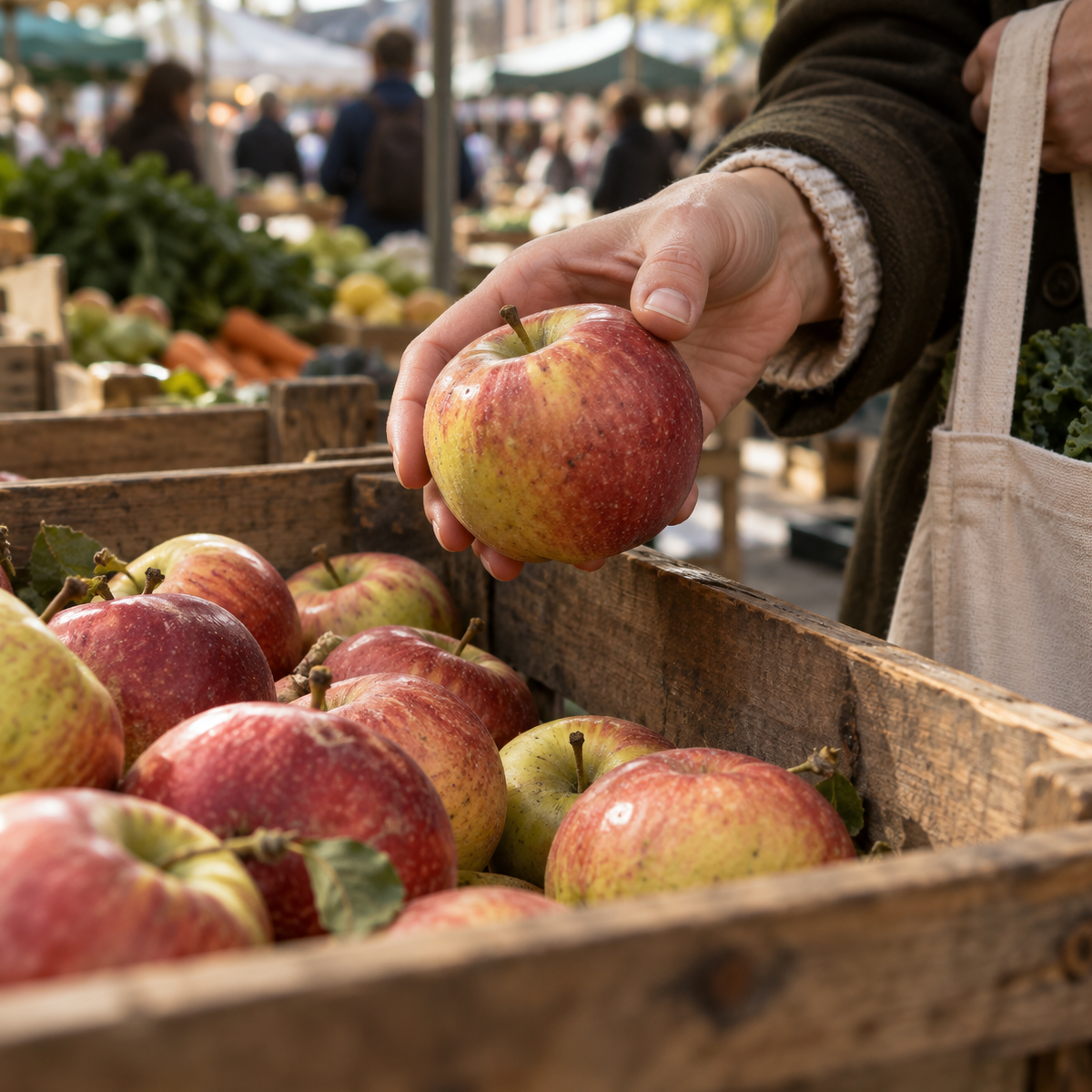
Late August and September sit at the turn of the market’s year, when the last of the summer fruit overlaps the first of the autumn crop. The seasonal run, as London Farmers’ Markets describes it, moves from summer’s cherries and tomatoes into apples, plums, sweetcorn and, as the weeks cool, game. The dependable pleasures are the named producers: oysters from Norfolk-based Longshore, a mushroom sandwich from The Mushroom Table, free range sausages from The Parsons Nose, raw milk from Midgham, and fruit and vegetables from farms including Perry Court, Chegworth Valley, Riverdale Organic and Wild Country Organics, alongside the plainly named and popular Potato Shop. Around the produce core, visitors report bakers with breads, pies and croissants, honey and flower stalls, a coffee truck, and a short line of hot food for the walk round. The tables amount to a running index of seasonal produce, which is precisely what separates this from a shop: what is here is here because it is ready now.
Fun fact: Unsold vegetables from the market are collected by FoodCycle, a charity that turns surplus produce into meals for people facing food poverty.
Shop it the way the producers price it, by season rather than by list. The best strategy for a first visit is a full lap before the first purchase, which takes ten minutes and prevents the classic error of filling a bag at the first fruit table when the better orchard is three pitches on. Card payments are widespread but not universal at markets of this kind, so a little cash still earns its place in a coat pocket. And buy the glut deliberately: when a single crop dominates several tables in the same week, that is the season speaking, and it is when Marylebone Farmers’ Market is at its cheapest and best.
The Market Against the Shops Around It
The obvious question, with La Fromagerie’s cheese room on Moxon Street and a Waitrose literally sharing a wall, is what Marylebone Farmers’ Market adds that the shops have not already covered. Set them against each other honestly and each wins on its own ground. The market wins on produce with a farm attached: fruit picked days ago, fish landed by the boat that sells it, game in season, and the conversation with the person who grew or caught what you are holding. La Fromagerie, whose Moxon Street shop with its walk-in cheese room sits a minute from the pitches, is the neatest illustration of the truce: a specialist shop that trades happily beside the stalls because they answer different questions. The shops win on everything a market cannot carry on a Sunday morning, depth of range, weekday hours, and the aged and imported goods that no British farm produces. The practised Marylebone Sunday uses both in one loop: the market first for the perishable and seasonal, the Moxon Street and High Street shops after for the rest. Treating Marylebone Farmers’ Market as a rival to the shops misreads it; the district’s food economy is built on the two trading side by side, and Sunday is the day the pairing shows.
Making a Morning of It
Arrive at Marylebone Farmers’ Market for the 10am start if you want first pick of anything scarce, or after midday if you prefer the calmer browse and can live with gaps on the tables. Dogs are welcome, and Paddington Street Gardens, a short walk away, is the sitting-down option for anything bought hot; the middle of the morning is the crush.
The timing shapes the crowd. The opening hour draws the serious shoppers with lists and trolleys; the middle stretch belongs to households doing the week’s fruit and vegetables; the final hour is the browsers’ shift, when queues shorten and stallholders have time to talk, which is where the market’s real education happens. Ask the questions then: which apple cooks and which eats, what the fishmonger would take home, when the game arrives in earnest. Those answers are the kind of knowledge no supermarket aisle carries, and they cost nothing in the last hour’s unhurried trade. Fold it into the district’s Sunday and the morning plans itself: the market from 10, the gardens or a High Street coffee after, and the shops of the High Street, which trade to Sunday hours, for whatever the stalls could not supply, with Daunt Books’ galleried Edwardian room a natural last stop before lunch. The whole circuit happens within five minutes’ walk of the Cramer Street pitch, which is the quiet advantage of a market that grew up inside a district rather than beside one.
The decision that makes the difference is simply when to set the alarm. Come for 10am with a shopping bag and a rough menu for the week, buy the seasonal thing you did not plan for, and let the named farms do the quality control they came to do. Marylebone Farmers’ Market has run on the same Sunday rhythm since 2003 because the format works: strict hours, real producers, and a district around it that finishes the shop. In early autumn, with the apples arriving and the game beginning, it is the best version of itself. The only mistake available is arriving at half past two.
Continue Reading
The Marylebone Gazette
Delivered weekly to your inbox
Join 12,000+ Marylebone insiders