One of those guitar moments that doesn't go as planned is the first time you plug in a distortion pedal. Some players fall in love with it right away. Some find the sound to be overpowering, ambiguous, or completely different from what they heard in the recordings that initially piqued their interest. Neither of these responses indicates whether you will eventually form a connection with distortion that becomes essential to your playing style, and both are entirely normal. Understanding what is truly going on, the true nature of the learning curve, and the reasons for the frequent discrepancy between expectations and first experiences are what are most helpful during those early sessions.
Why It Sounds Different Than Expected
Several different pedals have shaped the distortion heard on recordings. A particular amplifier in a treated acoustic environment has been subjected to equalisation, compression, and precise microphone placement by studio engineers. The final product of a series of choices made especially to make that distorted tone sound as good as possible in a recorded setting is what you hear through speakers or headphones.
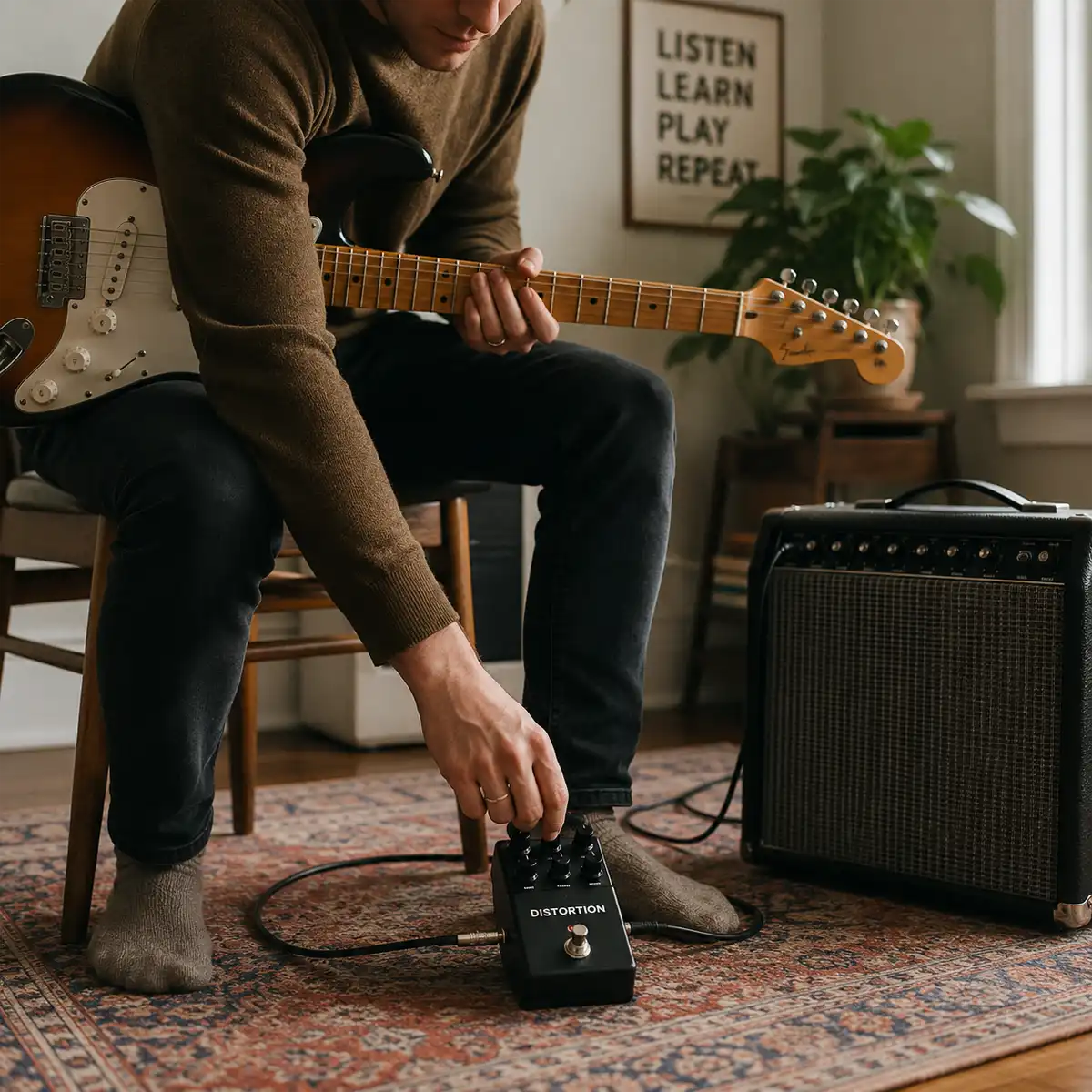
When a practice amplifier is connected to a distortion pedal in a bedroom with hard, reflecting walls, the result is far more raw. This does not imply that your setup is malfunctioning or that the pedal is incorrect. It indicates that you are experiencing distortion for the first time without the studio processing that gave the reference recordings their unique sound.
The discouragement that results from comparing a first-time bedroom sound to a produced track can be avoided by adjusting expectations at this point. Your favourite recordings are the result of years of experience, high-end gear, and studio know-how. Your first experience with a distortion pedal is not a performance evaluated by that benchmark, but rather the start of a learning process.
What the Controls Actually Do
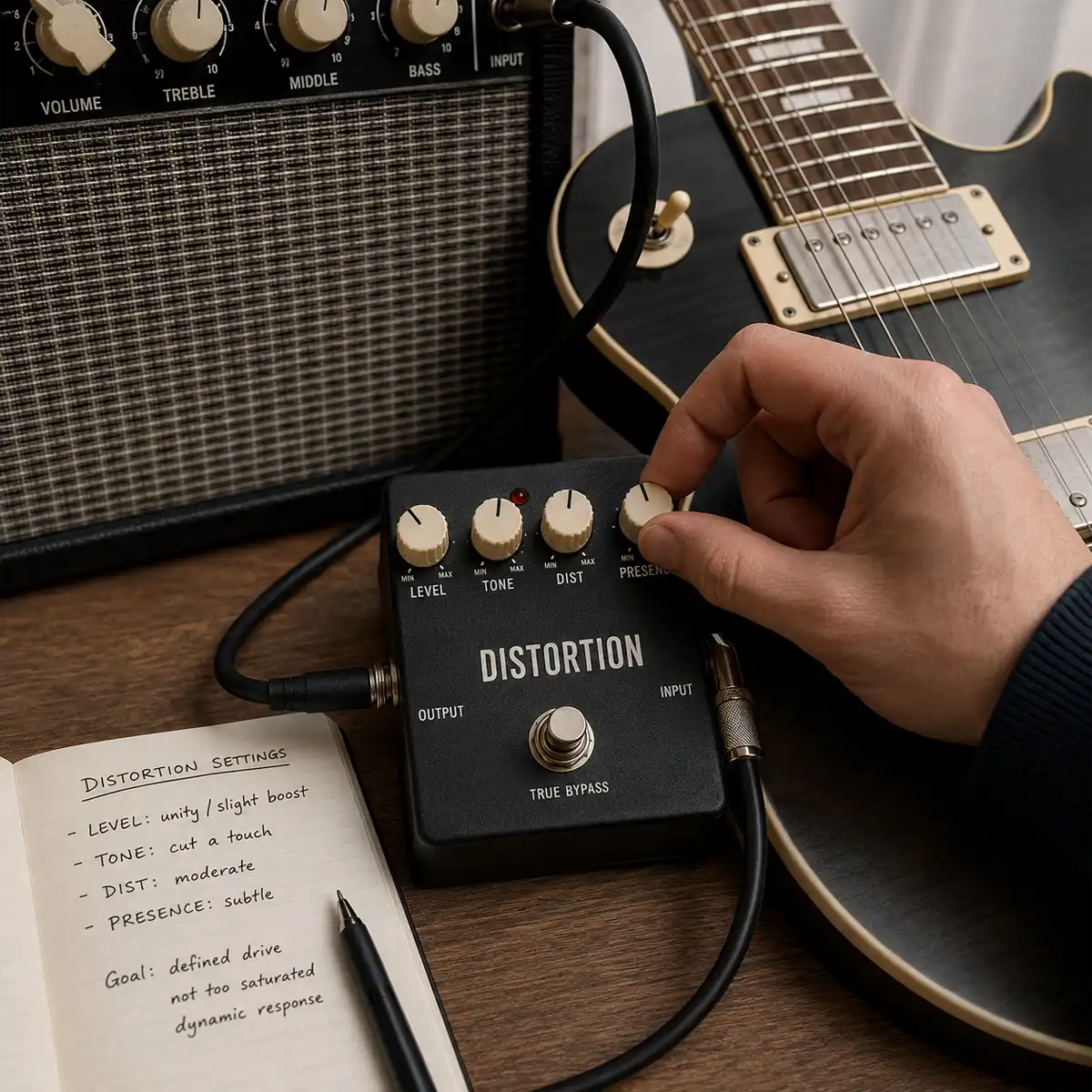
The majority of distortion pedals have three fundamental controls, albeit different manufacturers label them differently. The amount of signal compression and clipping is determined by the gain or distortion control, which ranges from light crunch at lower settings to heavy saturation at higher ones. The pedal's output level is adjusted by the volume or level control in relation to your bypassed signal. By boosting brightness at higher levels and rolling off treble at lower ones, the tone control modifies the distorted sound's frequency balance.
All of the parameters are frequently set to maximum at the same time by novice players, creating a sound that is incredibly bright, saturated, and possibly overwhelming. A more practical starting point is to match the volume to the bypassed guitar level, set the gain at about halfway, and set the tone just below the midpoint. From this position, you can truly learn how the pedal responds by altering each setting separately and paying close attention to what changes.
Gain and the Clarity Trade-Off
More gain does not always translate into greater tone, which is one of the first lessons distortion teaches. After a certain point, more gain compresses the signal so much that chords become a hazy wash instead of an identifiable harmonic form, and individual notes lose their distinction.
For the majority of playing scenarios, the sweet spot is far below maximum gain. Just enough saturation to create the required character and maintain it without completely sacrificing note clarity. It takes time and careful listening to find this balance, ideally by recording brief clips and replaying them instead of depending only on in-the-moment evaluation, which is almost as prone to distortion from the excitement of a new sound as the pedal itself.
How Technique Changes Under Distortion
An imprecise technique can be forgiven to some extent by clean tones. Distortion accentuates everything, including buzzing from incorrectly fretted notes, string noise from fingers changing places, and the sound of strings that should be hushed but are not.
Once recognised, this revealing nature is really helpful rather than disheartening. Playing through distortion reveals the precise areas where technique requires improvement. Muting strings that should be silent, fretting notes cleanly enough to prevent buzz, and managing pick attack to ensure dynamic consistency are all more instantly noticeable under gain than they were on a clean setup.
Building an Ear Over Time
Tone awareness develops gradually rather than arriving completely. Early sessions with a distortion pedal involve simply becoming familiar with what the effect does. Later sessions involve beginning to hear the difference between settings that work for a particular musical context and those that do not. Eventually, adjustments become intuitive rather than experimental.
This progression takes longer for some players than others, but it happens for everyone who keeps playing and keeps listening carefully. The ear that eventually guides confident tone decisions is built entirely through the accumulated experience of exactly those early, uncertain sessions.
Continue Reading
The Marylebone Gazette
Delivered weekly to your inbox
Join 12,000+ Marylebone insiders